

TOUCH BASE : March 2026 Edition

2026 Energy Benchmarking & Building Performance Standards Deadlines
The 2026 energy compliance season is here, and many cities and states have new energy benchmarking deadlines, building performance standards (BPS), and compliance requirements for commercial and multifamily buildings. Touchstone IQ’s 2026 benchmarking cycle roundup highlights key reporting dates, performance targets, and data verification deadlines to help you stay ahead of local and state regulations.
2026 By the Numbers
Percent of 2026 deadlines that have already passed as of March 2026
Benchmarking
BPS
Other
Benchmarking
Energy Benchmarking Deadlines - Next 90 Days

New Orleans
New Mandatory Benchmarking
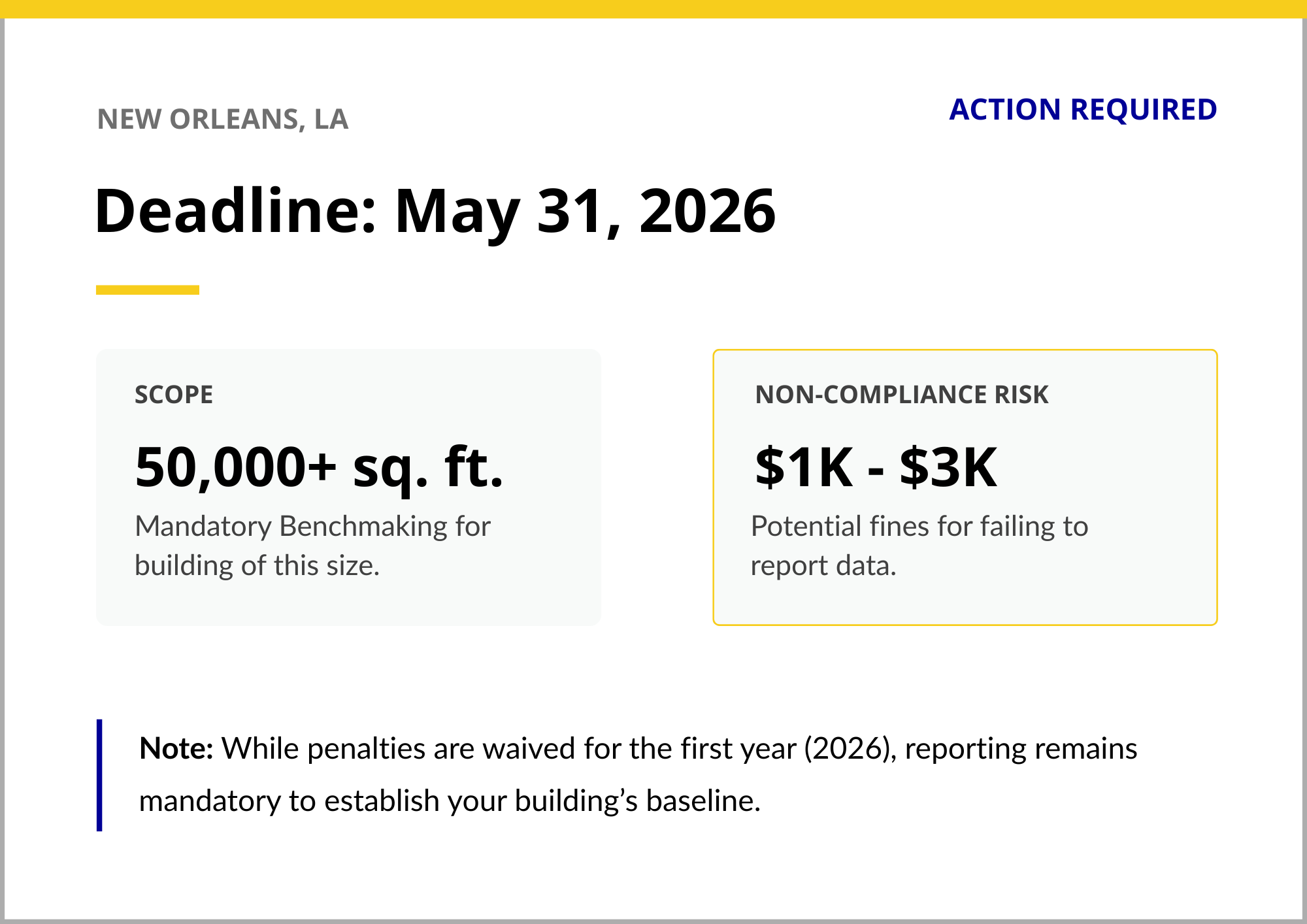
New Orleans passed its own mandatory energy benchmarking ordinance that will require buildings over 50,000 square feet to submit benchmarking data by May 31, 2026. While penalties are waived for the first year of compliance, buildings may face fines of $1,000–$3,000 for failing to report benchmarking data. These New Orleans energy benchmarking requirements apply to large commercial and multifamily buildings and create the city’s first mandatory energy benchmarking deadline in 2026.For more information on this ordinance, read our previously published article on the ordinance.
Minnesota State
Large Building Benchmarking
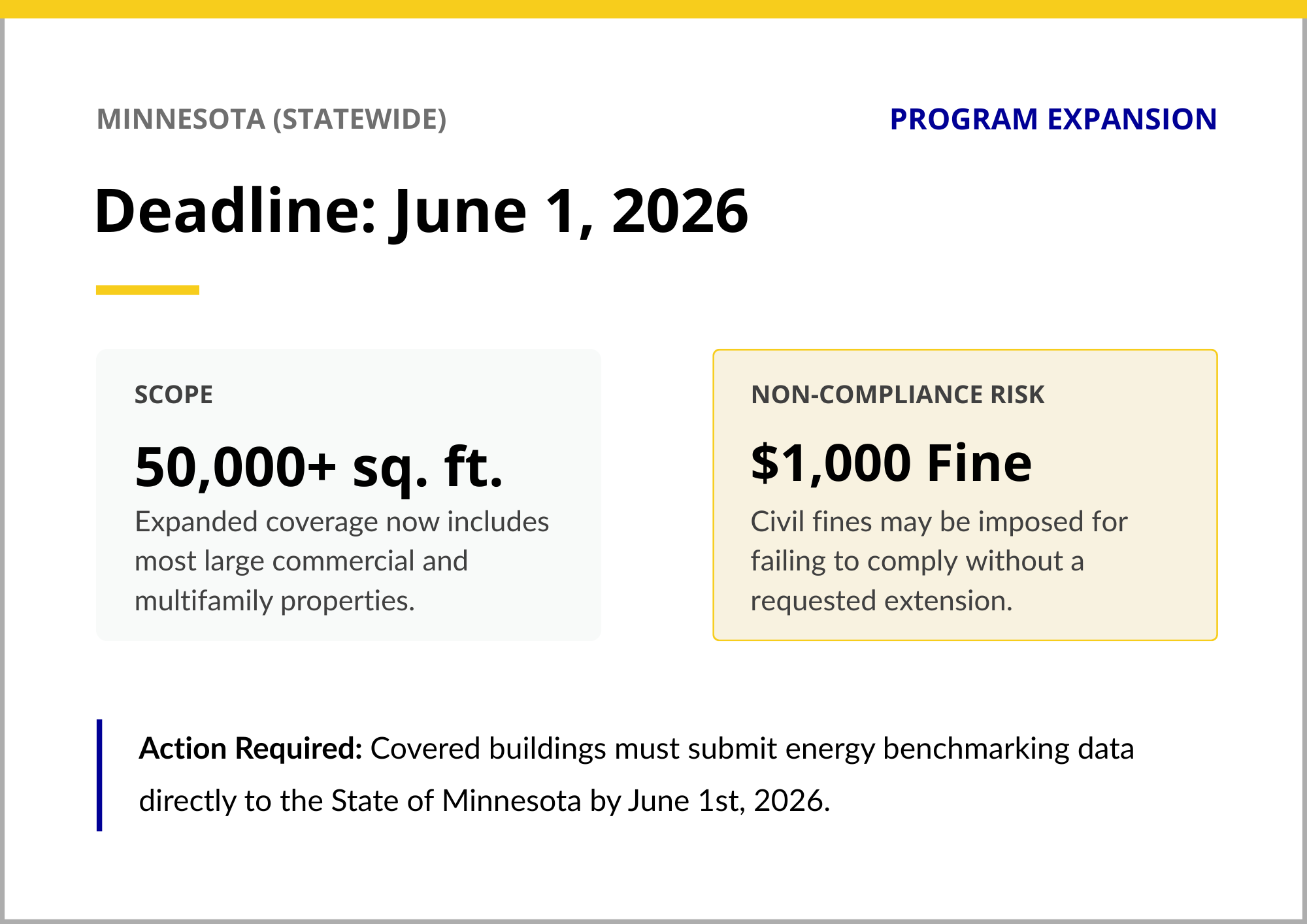
Minnesota is expanding its statewide energy benchmarking program this year to include additional large buildings. In 2026, the program will cover all buildings 50,000 square feet or larger, with buildings required to submit energy benchmarking data directly to the State of Minnesota by June 1, 2026. If a building does not request an extension and fails to comply with benchmarking requirements, Minnesota may impose a civil fine of $1,000. This statewide Minnesota energy benchmarking expansion means most large commercial and multifamily properties now have mandatory energy reporting in 2026.
Providence Benchmarking Requirements
Small Buildings
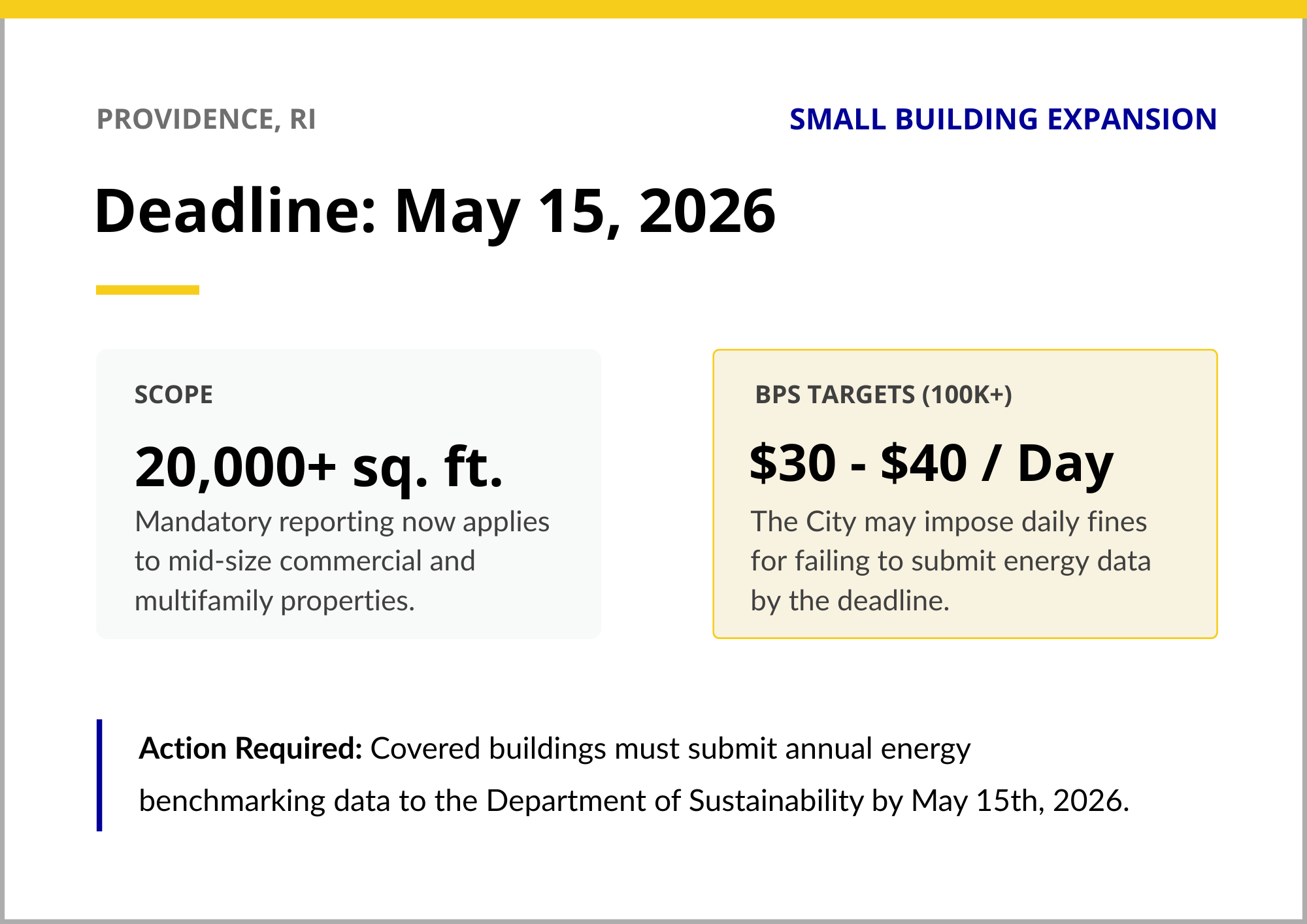
Providence is expanding its benchmarking program to include all buildings 20,000 square feet or larger. Buildings will be required to submit energy benchmarking data to the Department of Sustainability by May 15, 2026, or the City may impose a fine of $30–$40 per day. Providence’s 2026 small building benchmarking requirement significantly expands local energy reporting for mid size commercial and multifamily properties.
Lakewood
New Energy Benchmarking Program
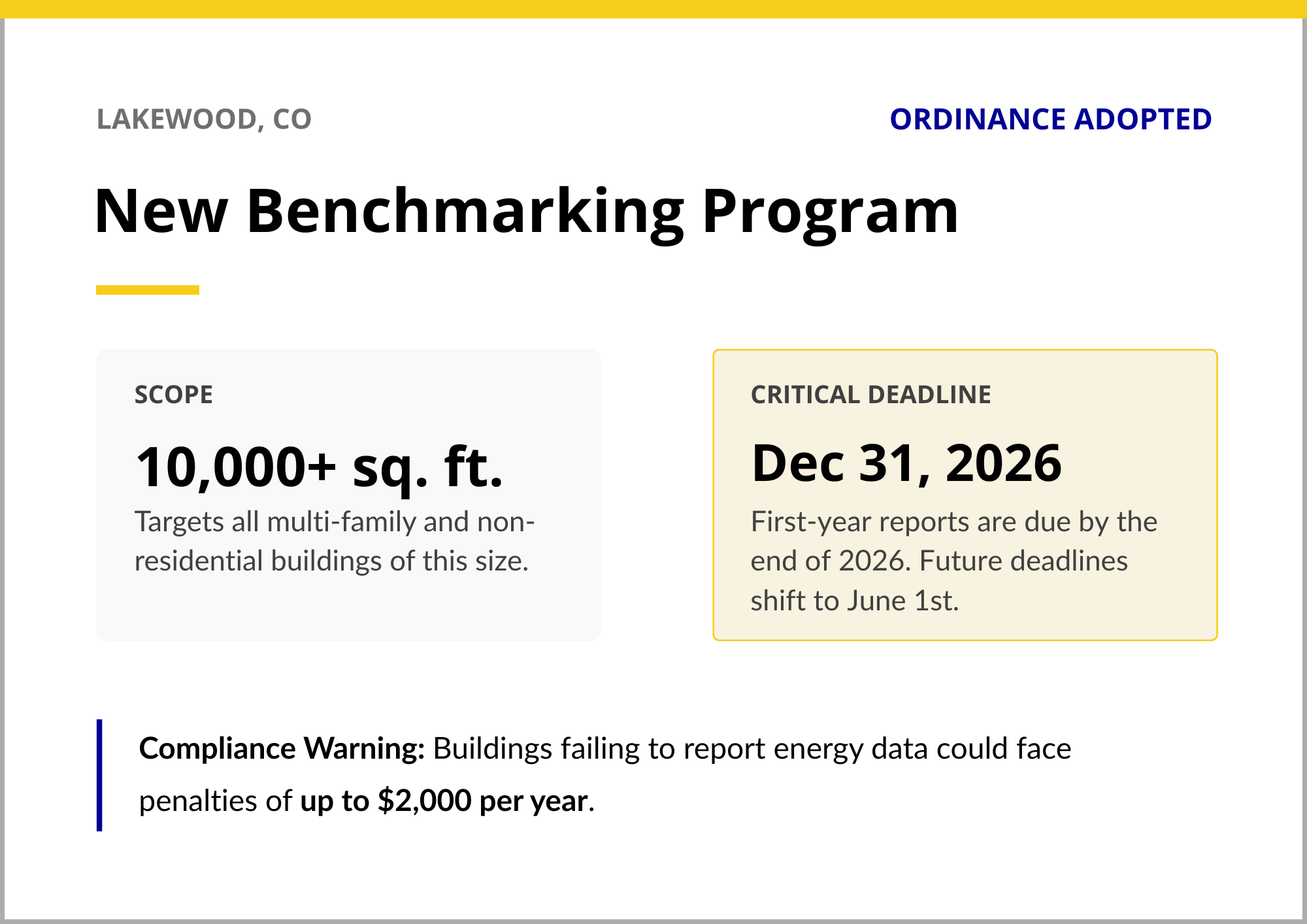
On a vote of 11-0, the City of Lakewood, Colorado adopted their own Energy Benchmarking ordinance. Targeting buildings 10,000 square feet and more, the benchmarking program shall be used to inform the development of a future Building Performance Standard. Beginning this year, all multi-family and non-residential buildings must report their energy benchmarking data by December 31st, 2026. In subsequent years, the annual reporting deadline will be June 1st. Buildings that are not compliant with the Lakewood program could face penalties up to $2,000 per year.
2026 Building Performance Standards (BPS) Targets

Cambridge
2026 Target Reporting Year
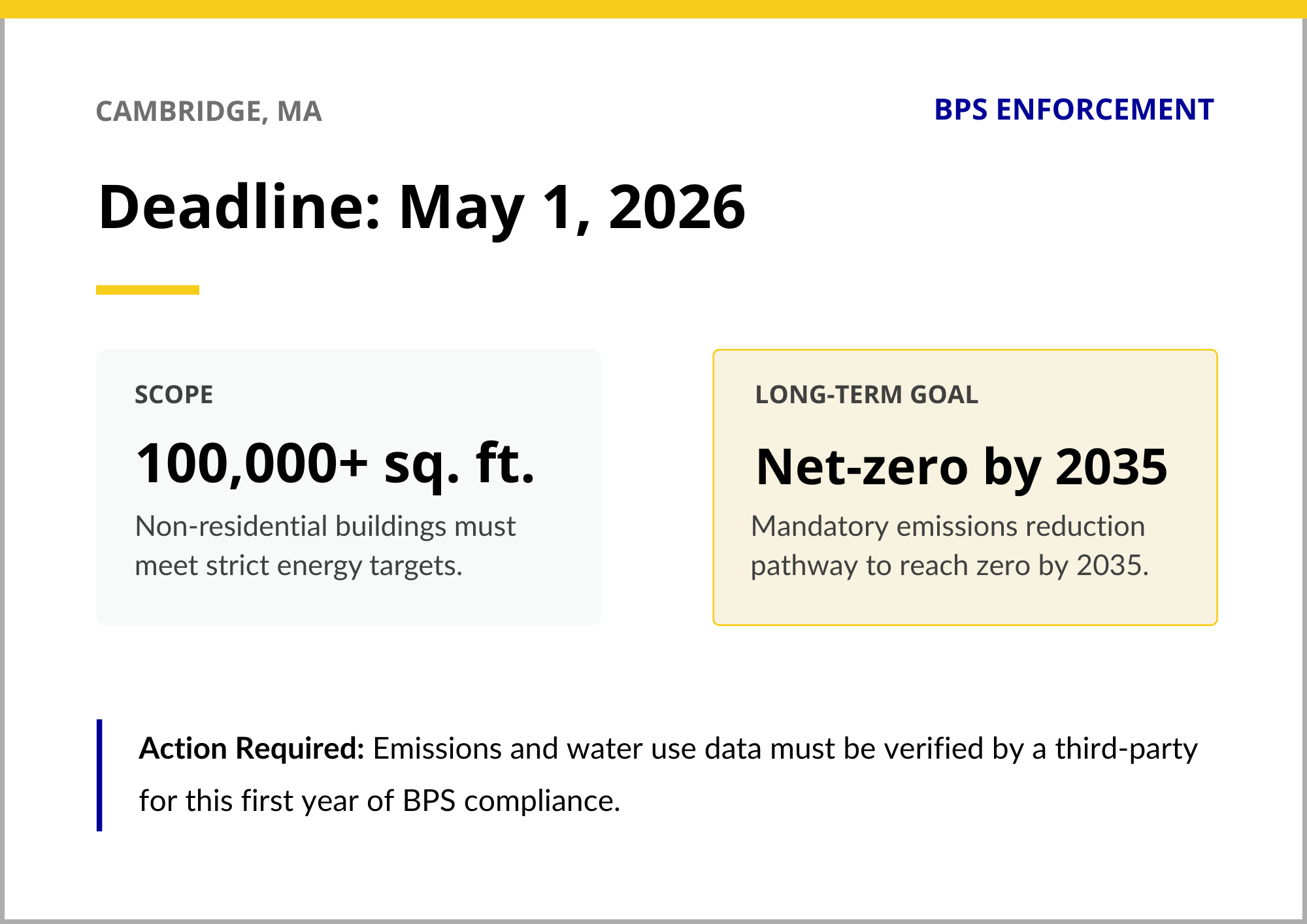
This year marks the first building performance standard target year under Cambridge’s Building Energy Use Disclosure Ordinance for covered non-residential buildings 100,000 square feet or larger. These buildings are required to meet energy or emissions targets, with the City requiring covered buildings to achieve net zero by 2035. Buildings must report their 2025 emissions data by May 1, 2026, and must have their emissions and water use data verified by a third party for the first year of compliance with the building performance standard. This makes 2026 a critical Cambridge building performance standards compliance year for large non-residential properties.
Washington State
BPS Begins This Year
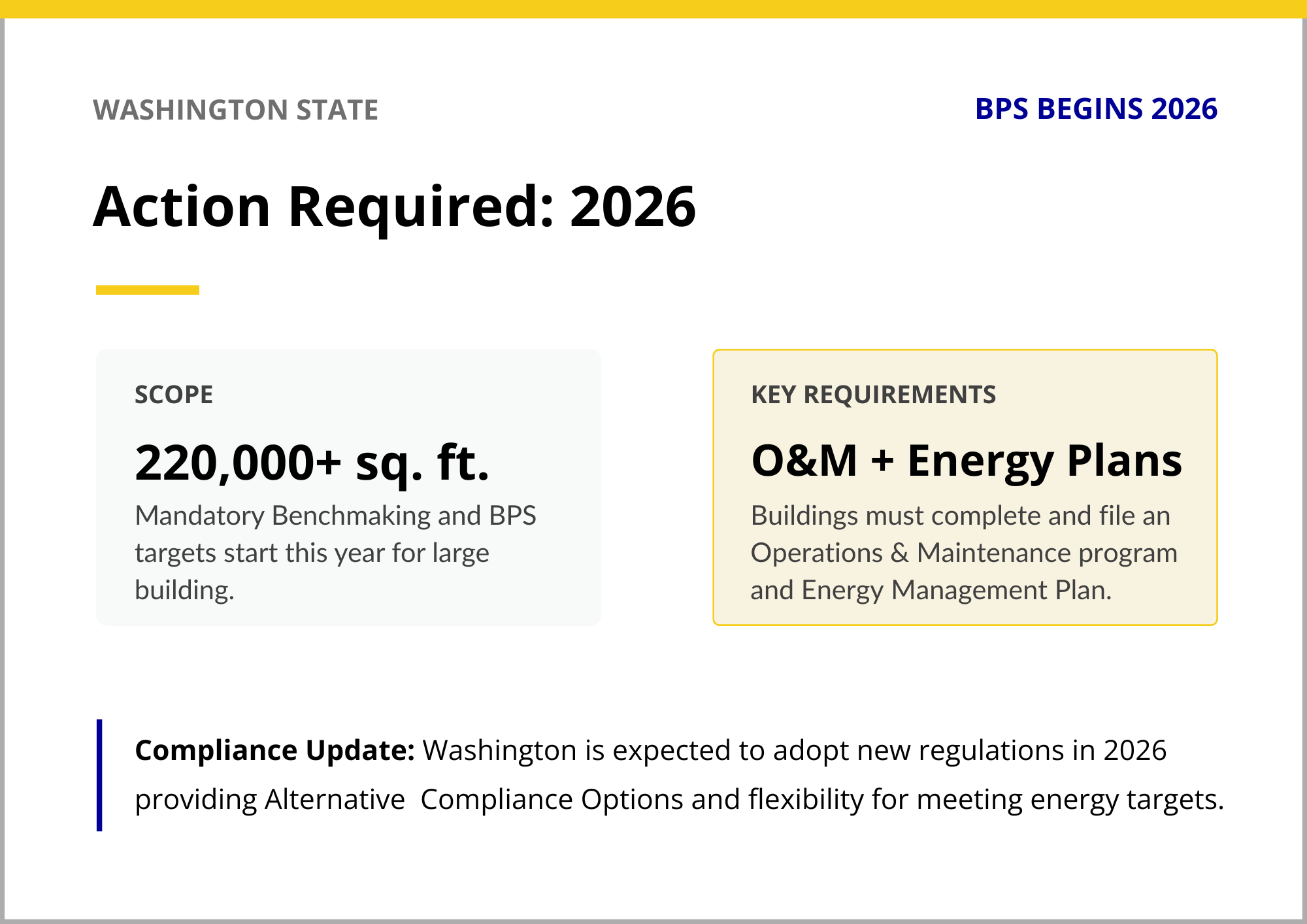
This year marks the beginning of Washington State’s Building Performance Standards program for large Tier 1 buildings. Washington requires buildings larger than 220,000 square feet to meet the Clean Buildings Performance Standard and report benchmarking and compliance documentation this year. As part of the reporting requirements, buildings must complete an Operations & Maintenance program and an Energy Management Plan to file with the state. In 2026, Washington is also expected to adopt additional regulations that provide alternative compliance options and flexibility for buildings to meet their energy targets. For many owners, this is their first Clean Buildings Performance Standard compliance year, making 2026 a critical deadline for Washington building performance standards.
2026 Performance Evaluation Years for BEPS/BPS
Washington D.C.
2026 Performance Evaluation Year
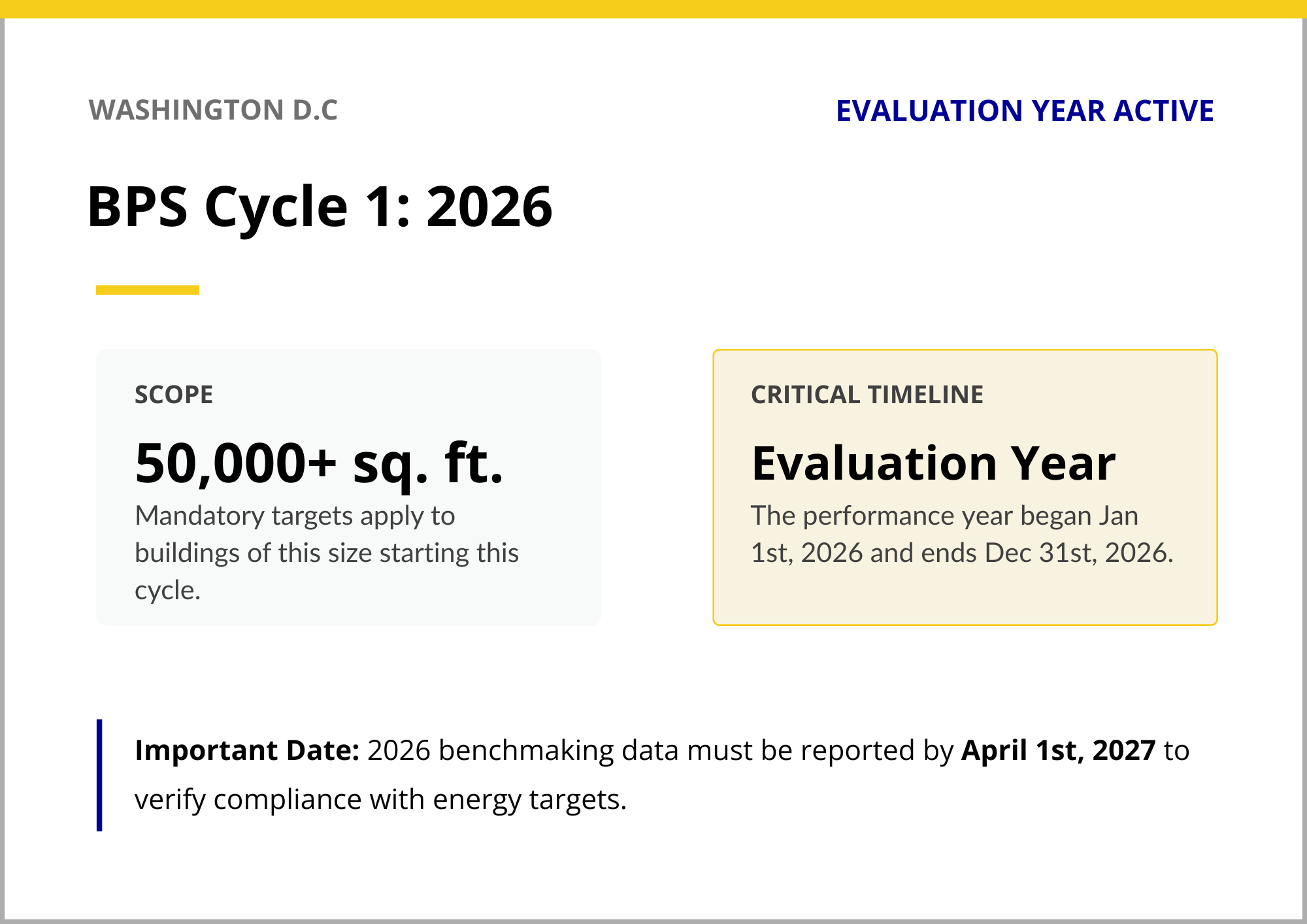
While the program has faced setbacks due to budgeting, Washington D.C. will begin its first Performance Evaluation Year under the Building Energy Performance Standards in 2026. Buildings that are 50,000 square feet or more will need to report their 2026 benchmarking data in 2027 to demonstrate whether they meet their performance targets (current guidance indicates a spring 2027 deadline). The performance evaluation year began on January 1, 2026, and will end on December 31, 2026. This 2026 performance evaluation year is a key milestone in Washington, D.C.’s building energy performance standards (BEPS) program.
Newton’s Last Year For Pre-BPS Improvements
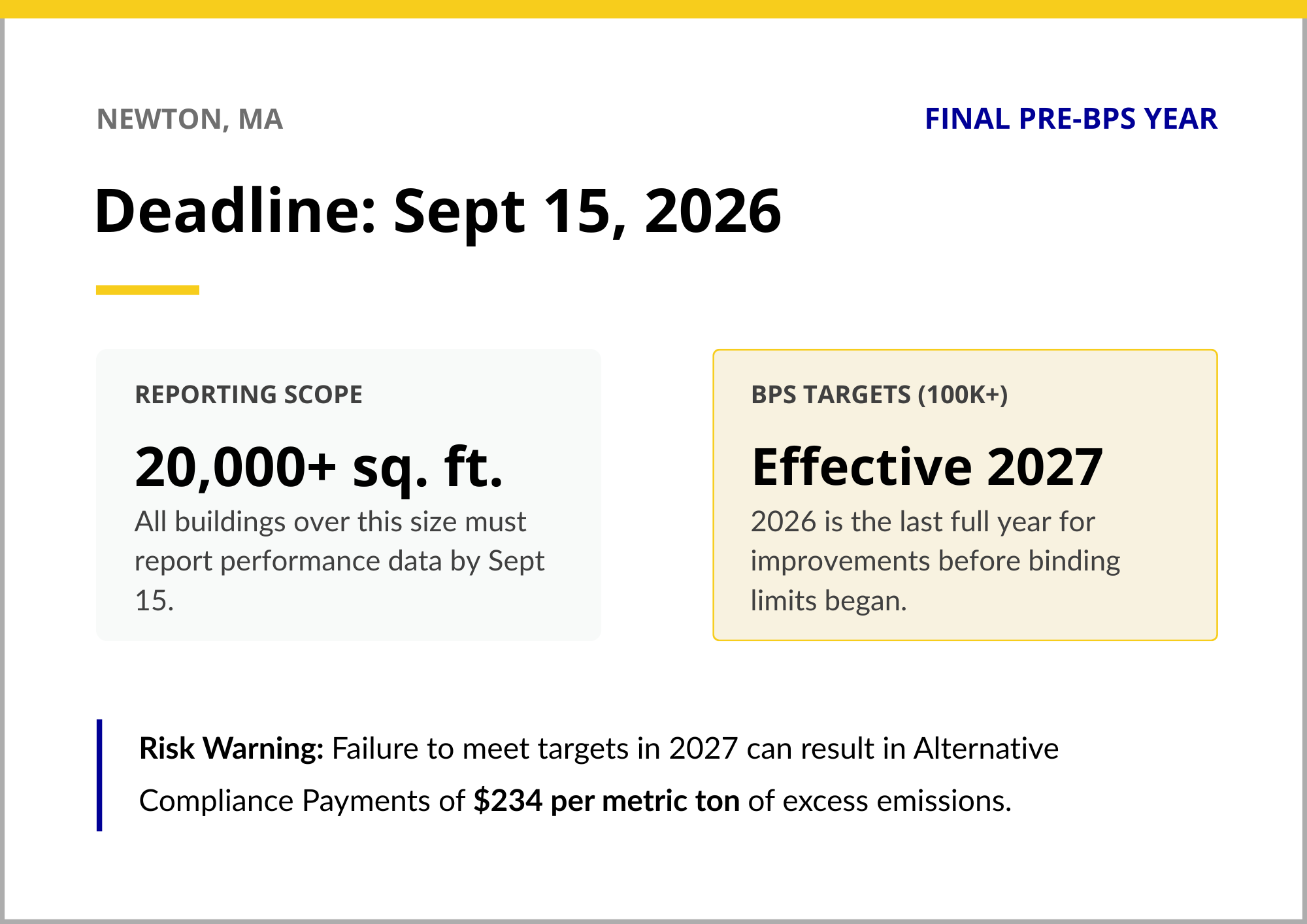
This year, buildings over 20,000 square feet in Newton, Massachusetts will begin reporting their energy performance. For buildings that are 100,000 square feet or greater, they must begin complying with emissions standard targets in 2027. That means 2026 is the last full year for these larger buildings to make improvements before performance standards take effect. Failing to achieve emissions targets may result in enforcement penalties or payments based on emissions per metric ton. Newton’s 2026 reporting year effectively serves as the final pre BPS improvement window for large buildings before emissions standards take effect.
Other Regulations
Building Tune-Ups For Building Performance
Buildings need to have regular maintenance and tune-ups in order to ensure operational efficiency. Building tune-ups check and adjust building energy systems to ensure systems are running efficiently without waste. Jurisdictions that have building tune-ups are expected to have reporting due in the later half of the year in order to give building owners time to conduct tune-ups.
The following cities have building tune-up requirements for 2026:

Data Verifications Required Across Many Jurisdictions
Having accurate and verifiable data is important for determining a building’s performance target and how much performance has to improve in order to achieve regulatory standards. In 2026, several jurisdictions will be requiring buildings to submit a Third-Party Data Verification for 2025 Data. Buildings will need to submit their verified report in order to meet regulatory requirements. Touchstone IQ is qualified to conduct Data Verifications in all jurisdictions.
The following jurisdictions will have Data Verification requirements in 2026:

Energy Audits & Retro-Commissioning Actions Required
Energy audits and retro-commissioning provide a detailed, investment-grade assessment of a building’s energy performance and identifies actionable energy conservation measures to support energy efficiency. Retro-commissioning often complements audits by systematically testing and tuning existing equipment and control sequences to optimize performance. Together, audits and retro-commissioning help building owners establish a clear energy baseline, prioritize energy efficiency measures, and develop a practical compliance plan for buildings to obtain efficiency.
The following jurisdictions have mandatory energy audit and retro-commissioning requirements in 2026:

Industry News
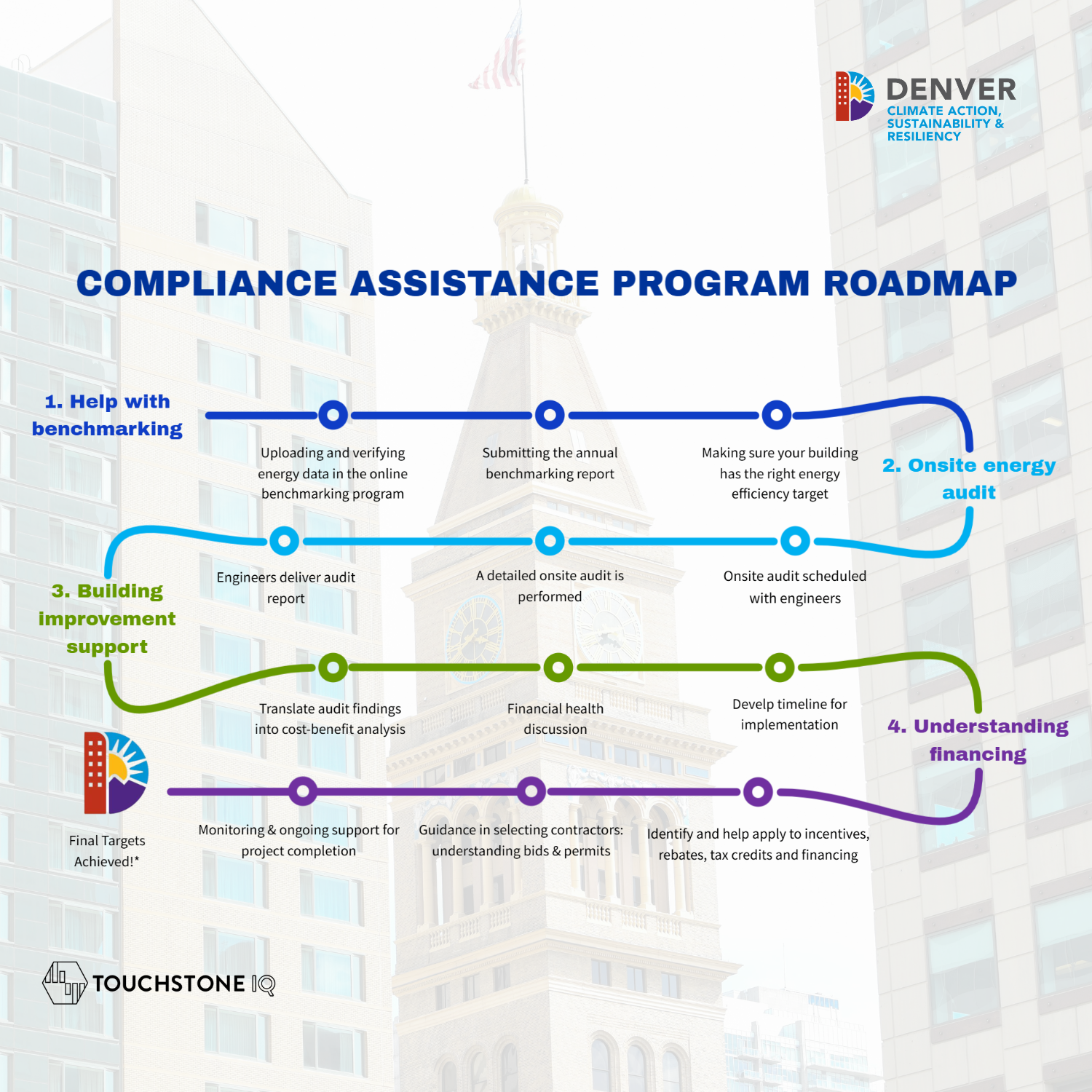
Energize Denver Featured for Unlocking Utility-Aligned Savings
Equity-first compliance support can do more than help buildings meet a policy deadline. When it is designed like a concierge-style service and connected to audits, incentives, and implementation, it can also create a real, utility aligned pipeline of savings. Our Director of Business Development, Ben Levine wrote about this in AESP’s Energy Intel (4th Quarter 2025, “For the People”), with a deep dive on Denver’s Compliance Assistance Program (CAP): “Equity First, Savings Follow: How Denver’s Compliance Assistance Program Unlocks Utility Aligned Savings” (starts on page 46).
2025 Government Impact Report
Across North America, building decarbonization is moving quickly from early pilots to full scale implementation, and 2025 made that shift unmistakable. Touchstone supported jurisdictions at every stage, tailoring each program to local goals, building stock, and stakeholder needs, while helping turn policy into durable, on the ground results. At the same time, a consistent set of market trends continued to accelerate: deeper equity focused support, more rigorous and data driven compliance, expanded software capabilities that reduce reporting friction, and high touch service models that improve both satisfaction and outcomes. Touchstone IQ recently released its 2025 Impact Report to showcase the progress we made with our government partners.
ENERGY STAR Receives Federal Funding
In January, Congress officially approved $33M in funding for ENERGY STAR for FY 2026. This is a major vote of confidence in a program that many wondered might be on the chopping block. Instead, it’s been reaffirmed as core infrastructure for benchmarking, compliance, and cost management across commercial real estate. For jurisdictions, owners, asset managers, and operators continued funding means regulatory consistency with their benchmarking and building performance data.
Your 2026 Compliance Checklist
