
Equity First, Savings Follow: How Denver’s Compliance Assistance Program Unlocks Utility-Aligned Savings
This article was originally published by the Association of Energy Services Professionals (AESP) Energy Intel Magazine (4th Quarter 2025).


Like many cities, Denver concluded that it cannot meet its climate goals without dramatically improving the performance of its existing buildings. The Energize Denver Building Performance Policy requires large buildings to benchmark annually and meet an energy efficiency goal. This policy is one tool the city is using to cut carbon pollution from the building sector.
Within that framework, the Compliance Assistance Program (CAP) was designed to answer a crucial question: what happens to buildings that serve climate-vulnerable communities, but lack the staff, capital, or expertise to navigate complex compliance rules on their own? Without help, these sites risk falling behind, facing fines, and missing out on the comfort, resilience, and cost benefits that the policy is supposed to deliver.
The CAP flips that script. It provides long-term, no-cost support to buildings that house or serve low-income residents, affordable housing, community nonprofits, and other frontline groups, so that they can meet Energize Denver’s requirements and share in the benefits of decarbonization.
For utilities and program implementers, CAP offers something more: a working template for an equity-first, concierge-style building performance program that generates a robust pipeline of demand-side management projects and aligns compliance-driven work with utility savings and equity goals. In effect, it functions like a utility Income Qualified or Hard-to-Reach building program that just happens to be anchored in a city BPS.
Building an Equity Lens Into Policy Implementation
Denver’s Office of Climate Action, Sustainability, and Resiliency (CASR) spent a full year co-designing the CAP with community stakeholders, technical advisors, and service partners before launch. The result was a shift in language from “under-resourced buildings” to “Equity Priority Buildings”, and a deliberate focus on frontline communities, including low and moderate-income residents, communities of color, older adults, non-English speakers, and others historically excluded from energy investments.
To identify candidates, CASR built an Equity Index that ranks census tracts based on environmental and socioeconomic indicators, then cross-referenced that index with data on large buildings (25,000+ sq. ft.) and affordable housing registries. This allowed the city to proactively target buildings in neighborhoods facing higher climate, economic, and housing burdens, which CASR refers to as “Equity Priority Buildings.”
Equity Priority Buildings are further defined by their role in serving climate-vulnerable communities; especially multifamily affordable housing, deeply affordable apartments, nonprofit service providers, and small businesses that operate on tight margins. Those buildings are eligible for deeper, longer-term assistance than the broader building stock, recognizing that compliance alone is not enough; they need embedded support to plan and execute improvements.
This deliberate equity lens mirrors a growing body of best practice in building performance standards and energy efficiency programs, which calls for policy goals and metrics that prioritize equitable access and outcomes, not just maximizing cost-effective savings. It also lines up closely with where utility portfolios are headed, as regulators increasingly expect equity, decarbonization, and reliability benefits to be delivered together rather than in separate silos.
Program Architecture: Service Levels, Not One-Size-Fits-All
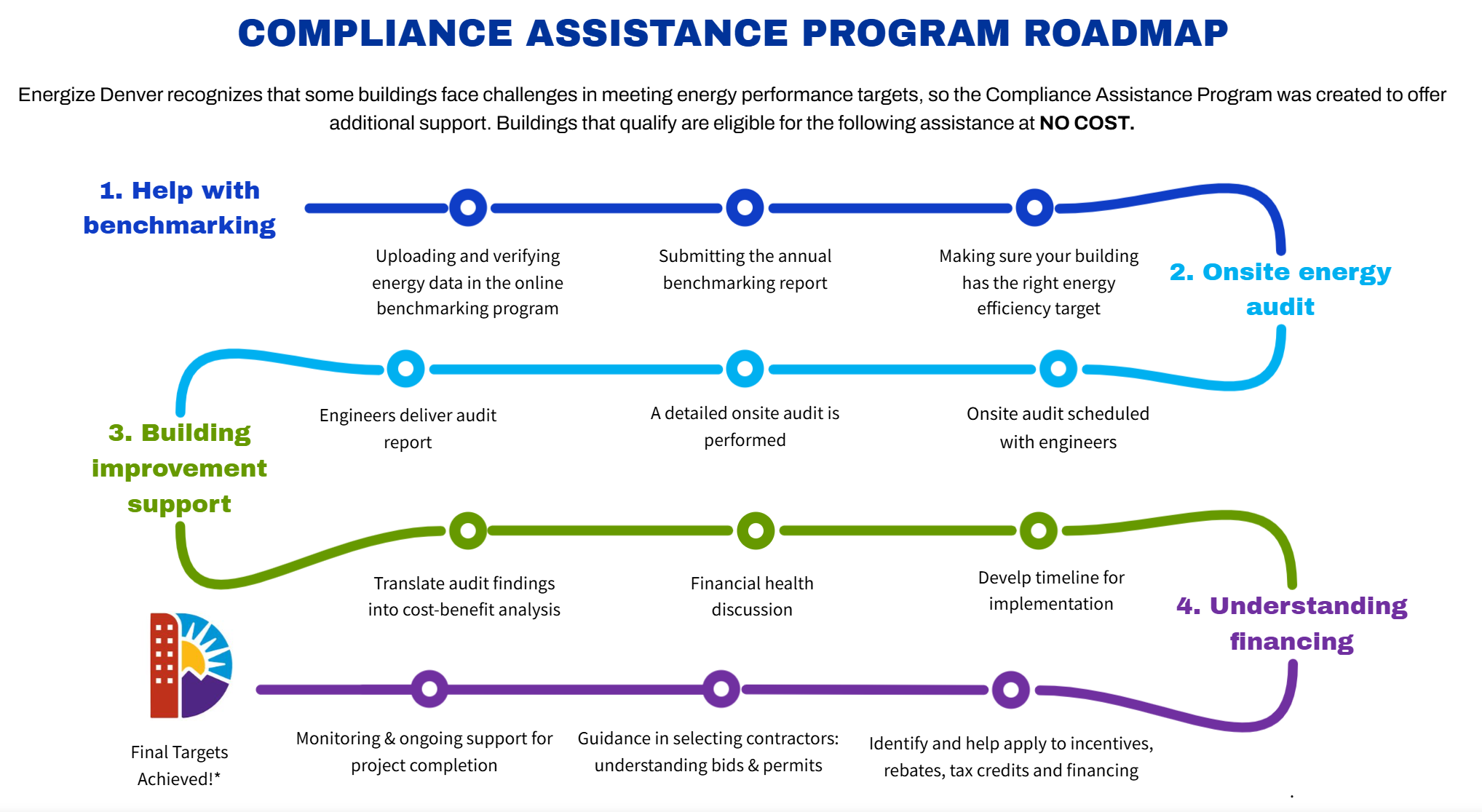
Support within CAP is structured as a five-step continuum that aligns assistance with each building’s needs and readiness, from first touch to post audit follow through. Rather than a single audit offering, the program stages services so that owners get the right level of help at the right time.
Step 1: Outreach and Screening
Targeted outreach and application screening identify buildings that meet Equity Priority Building criteria and are likely to benefit most from the concierge support offered in the CAP. Staff explain Energize Denver requirements in plain language, describe the services available, and enroll buildings into the program.
Step 2: Benchmarking and Data Verification
Program staff provide hands-on benchmarking support by setting up or cleaning up ENERGY STAR Portfolio Manager accounts, uploading and verifying utility data, correcting square footage and use types, and submitting required benchmarking reports on behalf of owners when needed.
Step 3: Assessment and Audit Preparation
Once data is accurate, the team completes a virtual assessment using building information and engineering analysis to flag key opportunities, identify potential target adjustment or alternate compliance options, and gather the information needed to scope an effective onsite ASHRAE Level 2 audit.
Step 4: Onsite ASHRAE Level 2 Audit and Compliance Plan
Engineers conduct a comprehensive onsite ASHRAE Level 2 audit and, working with the account manager, translate the technical findings into a phased, cost-benefit-informed plan for meeting Energize Denver targets over multiple compliance years. The plan highlights measure bundles, timelines, and connections to incentives and financing.
Step 5: Post Audit Account Management and Implementation Support
After the audit, CAP account managers stay engaged to review findings with the owner, refine the compliance and project plan, help with target adjustments or other formal submissions, and support the owner as they pursue incentives, select contractors, and move into implementation.
Each participant in the CAP is assigned a dedicated account manager who serves as a single point of contact across all five steps The account manager creates building accounts in the city’s software platform Touchstone IQ, syncs existing benchmarking data, reviews performance targets, and helps the owner understand how far they are from current and future compliance thresholds. They then work with engineering partners to move the building into audit preparation and, ultimately, into implementation.
“Equity Priority Buildings are the definition of hard to reach. They are busy, resource constrained, and often overwhelmed by competing demands. When we show with long term, no cost support and stay with them from benchmarking through implementation, we see a level of engagement that traditional programs have struggled to unlock.”
The graphic below provides a simple picture of this journey: starting with benchmarking assistance, moving through onsite audits and building-improvement support, and ending with help understanding financing and incentives. For utilities, this progression will feel familiar. It looks very much like the upstream funnel of a comprehensive efficiency program, with clear stages from awareness, to data, to scoping, to projects.
The Owner Journey: From Confusion to a Concrete Plan
From an owner or property manager’s perspective, the CAP is designed to feel more like a concierge service than a traditional compliance program.
Recruitment and Enrollment: Many participants first hear about CAP through targeted outreach informed by the Equity Index: phone calls, emails, and site visits that explain the program in plain language and invite them to apply. Staff use scripts that position the program as free, tailored support tied directly to Denver’s performance requirements, with benefits like hands-on benchmarking help and no-cost Level 2 audits.
Kick-Off Call and Data Cleanup: Once approved, each building receives an approval email and schedules a kick-off call. Prior to the call, owners are asked to gather basic documentation (ESPM credentials, floor-area documentation, utility account information) so that staff can immediately start data verification and benchmarking.
On the call, the account manager walks the owner through Energize Denver requirements, reviews existing data, and sets expectations for the timeline and service levels ahead. They also initiate full-service benchmarking support: correcting square footage, ensuring meters match, and submitting reports on the owner’s behalf when needed.
Assessment and Planning: After accurate data is in place, buildings move into a virtual assessment and then onsite ASHRAE Level 2 audits for the highest-priority sites. Engineers conduct detailed onsite evaluations and, working with the account manager, produce a compliance-focused deliverable that shows how different measure packages map to near-term and long-term performance targets.
Navigation and Implementation Support: Post-audit, CAP account managers stay involved, helping owners interpret audit findings, evaluate timelines, and connect to incentives, rebates, and financing resources. Program SOPs call for ongoing check-ins, support with compliance forms (target adjustments, alternate compliance pathways, extensions), and coordination with contractors.
Importantly, the program tracks each building’s status in the shared Touchstone IQ platform, from initial contact to “post-audit implementation”, so that no site falls through the cracks. For a utility audience, this is essentially an equity-focused energy advisor model that spans the full customer lifecycle rather than a one-and-done audit.[ES1]
Does It Work? Early Results From the Pilot and Expansion
The pilot year results provide a first look at how an equity-first assistance model performs in practice.
