
TOUCH BASE : June 2026 Edition

2026 Energy Benchmarking & Building Performance Standards Deadlines
The biggest reporting wave of 2026 is now behind us – 23 jurisdictions reported on June 1st, including Washington State’s first Building Performance Standard reporting. With roughly two-thirds of the year’s benchmarking and BPS deadlines complete, our latest TouchBase looks at what remains ahead and how to begin planning your summer for upcoming compliance years.
2026 By the Numbers
2026 compliance deadlines passed as of June 22nd, 2026 — 24 benchmarking and 1 BPS deadlines still ahead.
Benchmarking
Energy Benchmarking Deadlines - Next 90 Days
Below are all the mandatory benchmarking deadline falling within the 90 days following this edition's June 22nd publication date. Deadlines are grouped by reporting window, mirroring Touchstone IQ's 2026 deadlines list. Owners with properties in any jurisdiction below should confirm coverage, finalize data pulls, and line up third-party verification where required before the filing date.
Missed A Deadline? What Do You Do Now?
Energy benchmarking deadlines can be difficult to track throughout the course of the year. If you missed a deadline, there is a solution available. Many jurisdictions offer a deadline extension request, in which buildings may apply to receive an extension to submit their annual benchmarking reporting. An extension request may involve the submission of a specific form on the jurisdiction’s website with qualifying reasons or as simple as emailing the program seeking an extension. For example in Colorado, building owners must submit an extension request by October 15th in order to get a time extension to November 15th, 2026. If your building has missed a deadline, it is important to immediately request a deadline extension in order to potentially avoid penalties for failure to submit benchmarking.
Group 2 | Remainder of June
Group 3 | July
Group 4 | August
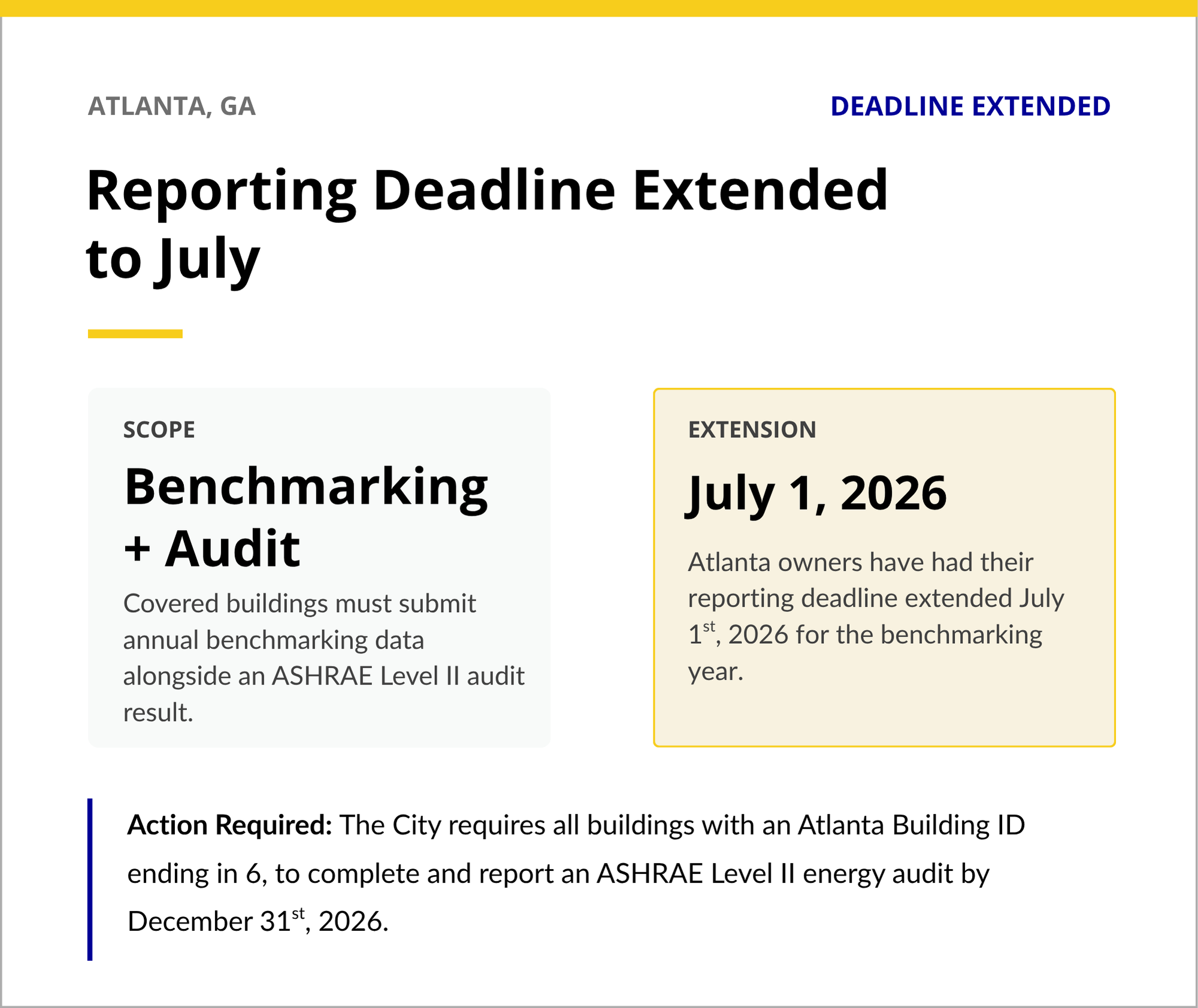
Atlanta owners have had their reporting deadline extended July 1st, 2026 for the benchmarking year. Covered buildings must submit annual benchmarking data along with the buildings required to conduct an ASHRAE Level II energy audit. The City requires all buildings with an Atlanta Building ID ending in 6, to complete and report an ASHRAE Level II energy audit by December 31st, 2026.
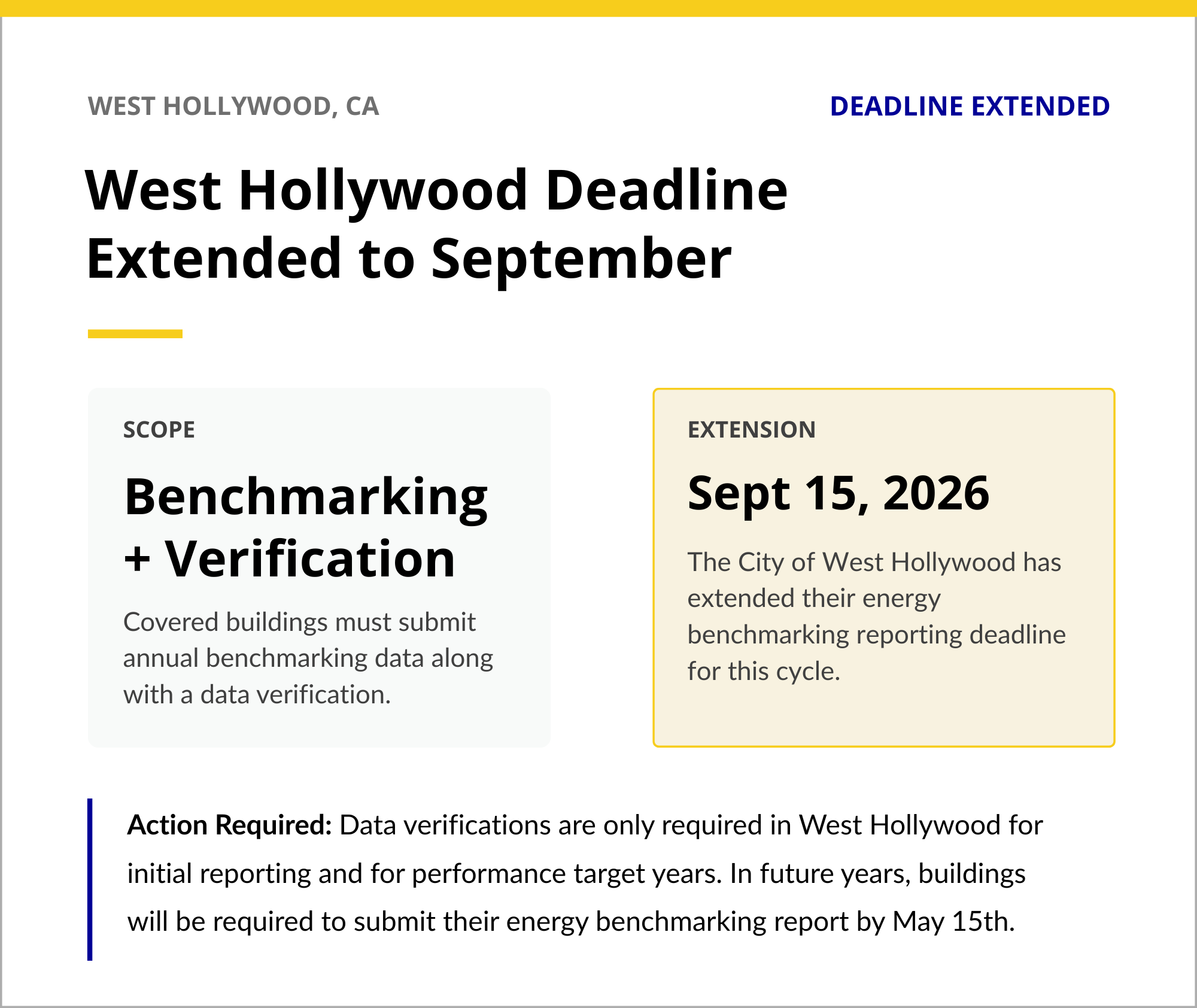
West Hollywood
The City of West Hollywood has extended their energy benchmarking reporting deadline to September 15th, 2026. Covered buildings must submit annual benchmarking data along with a data verification. In future years, buildings will be required to submit their energy benchmarking report by May 15th. Data verifications are only required in West Hollywood for initial reporting and for performance target years.
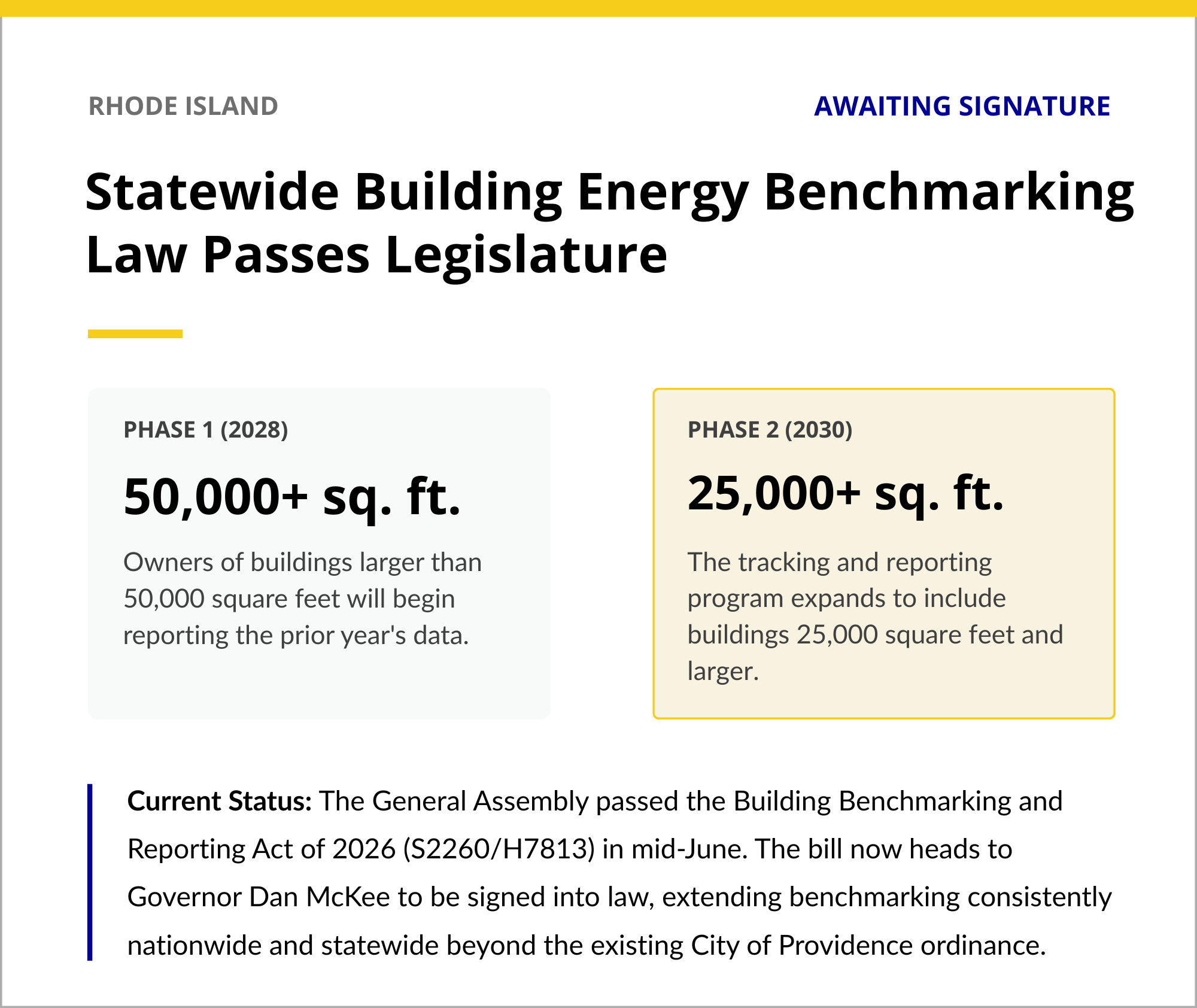
Rhode Island is on the verge of becoming the latest state to require energy and water benchmarking for large buildings. The General Assembly passed the Building Benchmarking and Reporting Act of 2026 (S2260/H7813) in mid-June, with the Senate approving it 33-5 and the House following in concurrence 50-16. The bill now heads to Governor Dan McKee, and advocates are waiting to see whether he signs it into law.
The act establishes a statewide program for tracking and reporting the energy and water performance of large buildings, creating a centralized database that gives owners and the state a clearer picture of how these properties consume energy and where reductions are possible. The requirements phase in over time: starting in 2028, owners of buildings larger than 50,000 square feet will report the prior year's data, with buildings 25,000 square feet and larger joining the program in 2030. The measure also lays the groundwork for a future energy performance standard.
For Rhode Island, the law would mark a significant step toward the emissions-reduction mandates set under the state's Act on Climate. It would also extend benchmarking beyond the City of Providence, which already requires large commercial, institutional, and multifamily owners to report energy use through its Building Energy Reporting Ordinance — bringing a consistent, statewide approach to a policy that more than two states and over thirty municipalities have now adopted nationwide.
2026 Building Performance Standards (BPS) Targets

Washington State
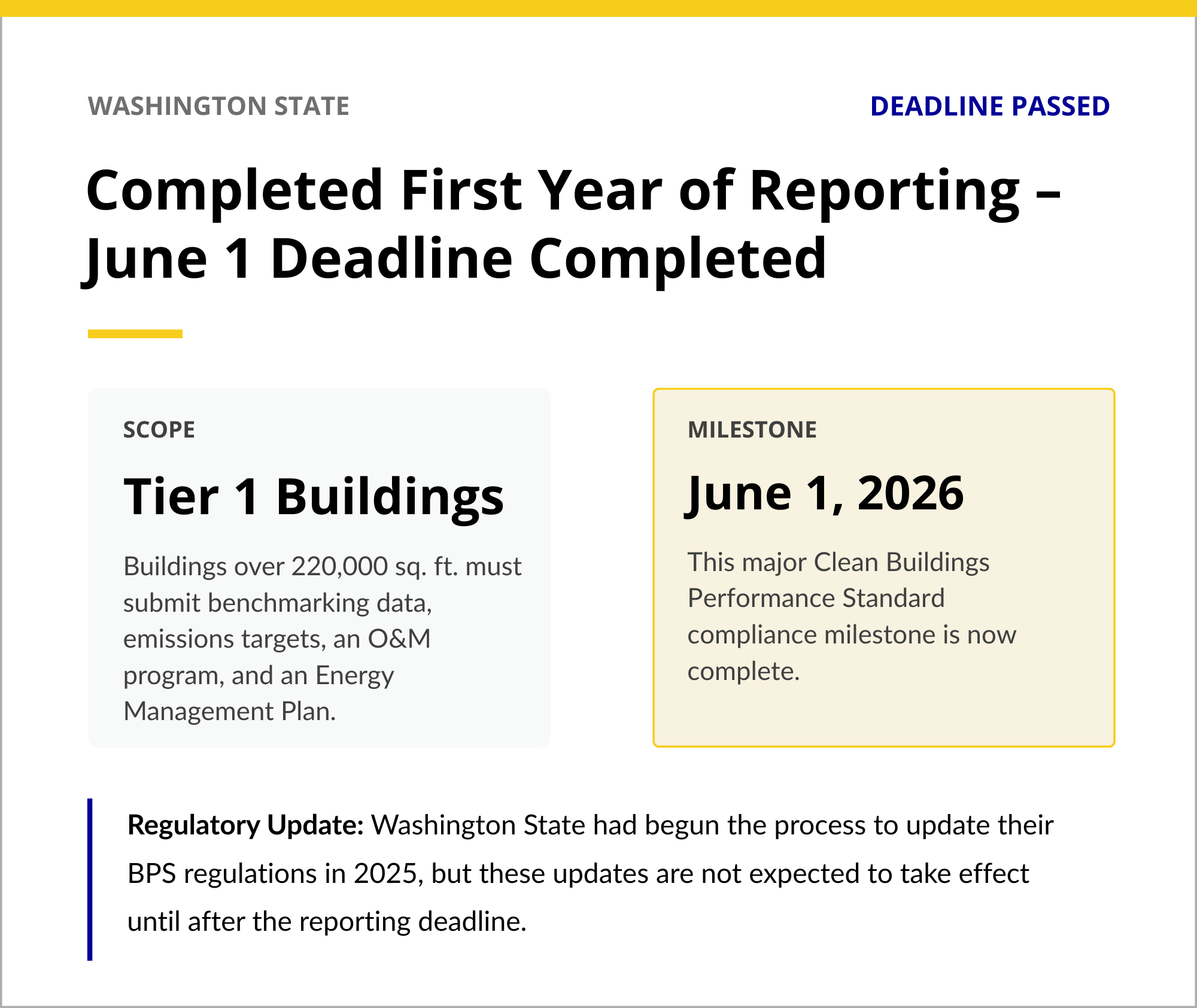
Washington State's Clean Buildings Performance Standard is the clearest example of a major upcoming June 1, 2026, compliance milestone. Tier 1 buildings over 220,000 square feet must complete benchmarking, achieve their emissions target and submit required compliance materials, such as an Operations and Maintenance program and an Energy Management Plan. Washington State had begun the process to update their BPS regulations in 2025, but these updates are not expected to take effect until after the reporting deadline.
Columbus, OH
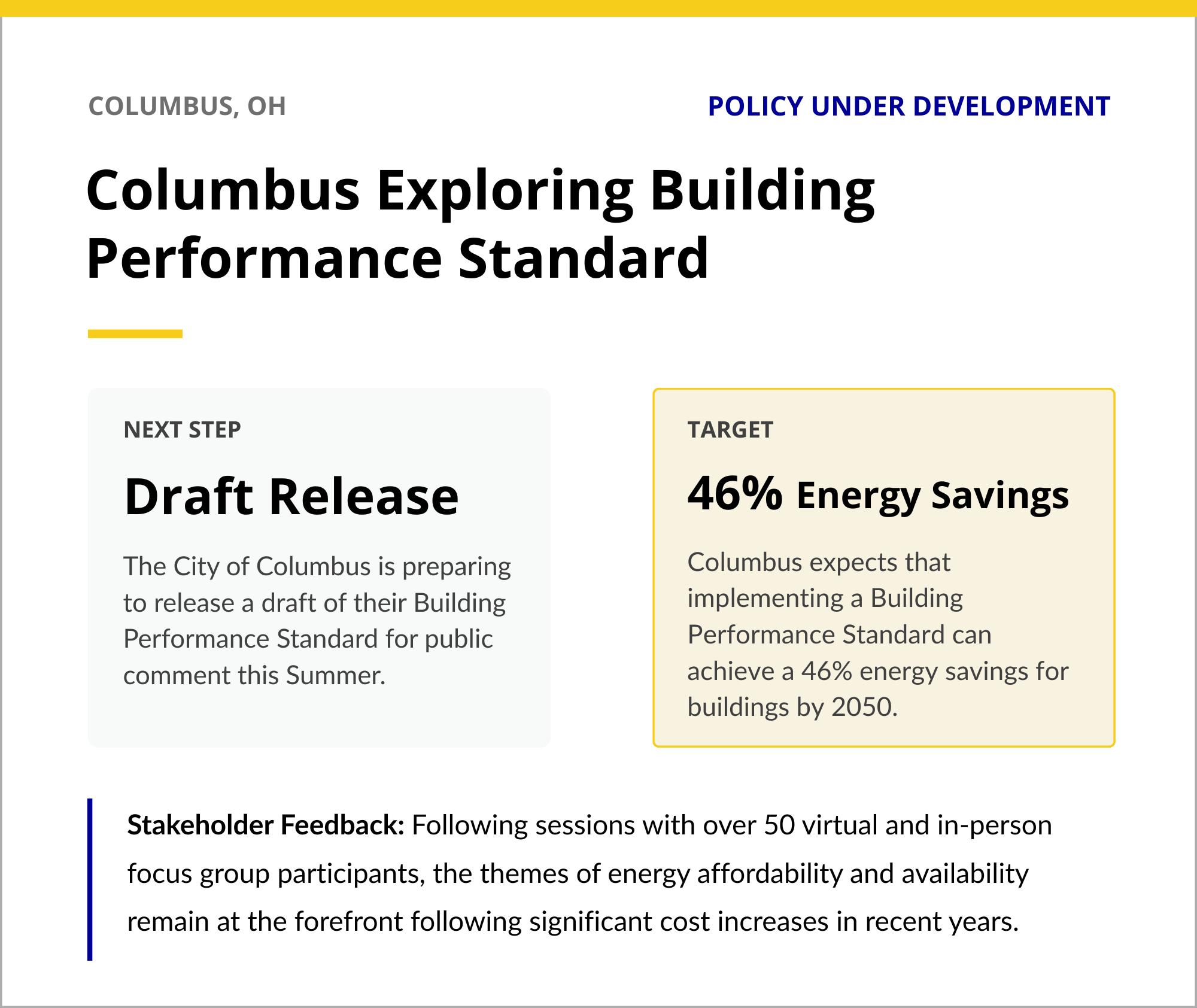
Columbus Exploring Building Performance Standard
After several sessions with stakeholders, the City of Columbus is preparing to release a draft of their Building Performance Standard for public comment this Summer. Columbus held virtual and in-person focus groups, with over 50 participants attending and providing feedback on the development of the Building Performance Standard. Both residents and building owners have reported significant increase in energy costs over the last few years, with the theme of energy affordability and availability being at the forefront of feelings. Columbus expects that by implementing a Building Performance Standard, Columbus can expect a 46% energy savings for buildings by 2050.
Washington D.C.
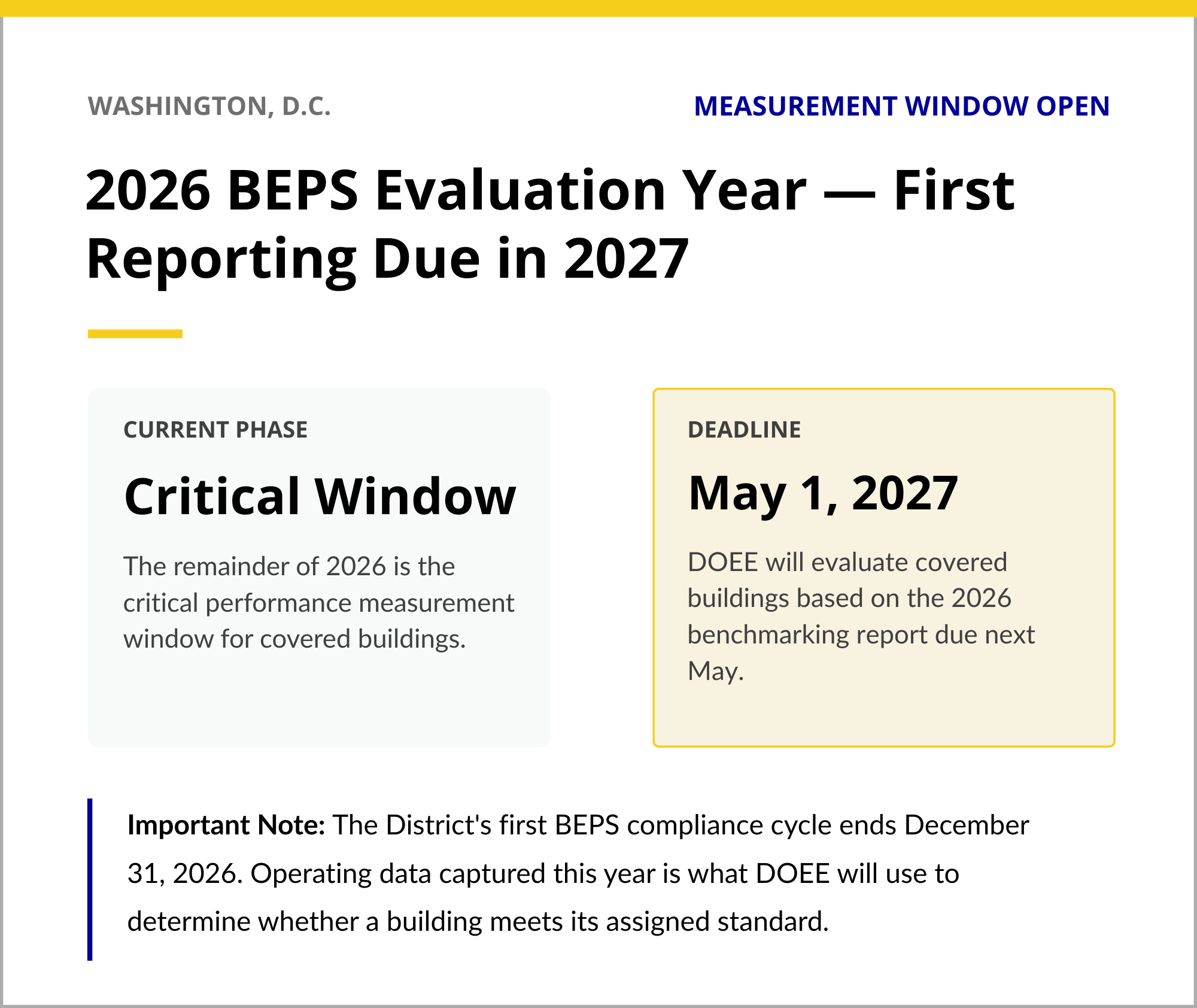
Washington, D.C.'s May 1, 2026, deadline was an annual benchmarking filing, not a BEPS reporting milestone. The District's first BEPS compliance cycle ends December 31, 2026, and DOEE will evaluate covered buildings in 2027 based on the 2026 benchmarking report due May 1, 2027. That makes the remainder of 2026 the critical measurement window for owners on the performance pathway: operating data captured this year is what DOEE will use to determine whether a building meets its assigned standard.
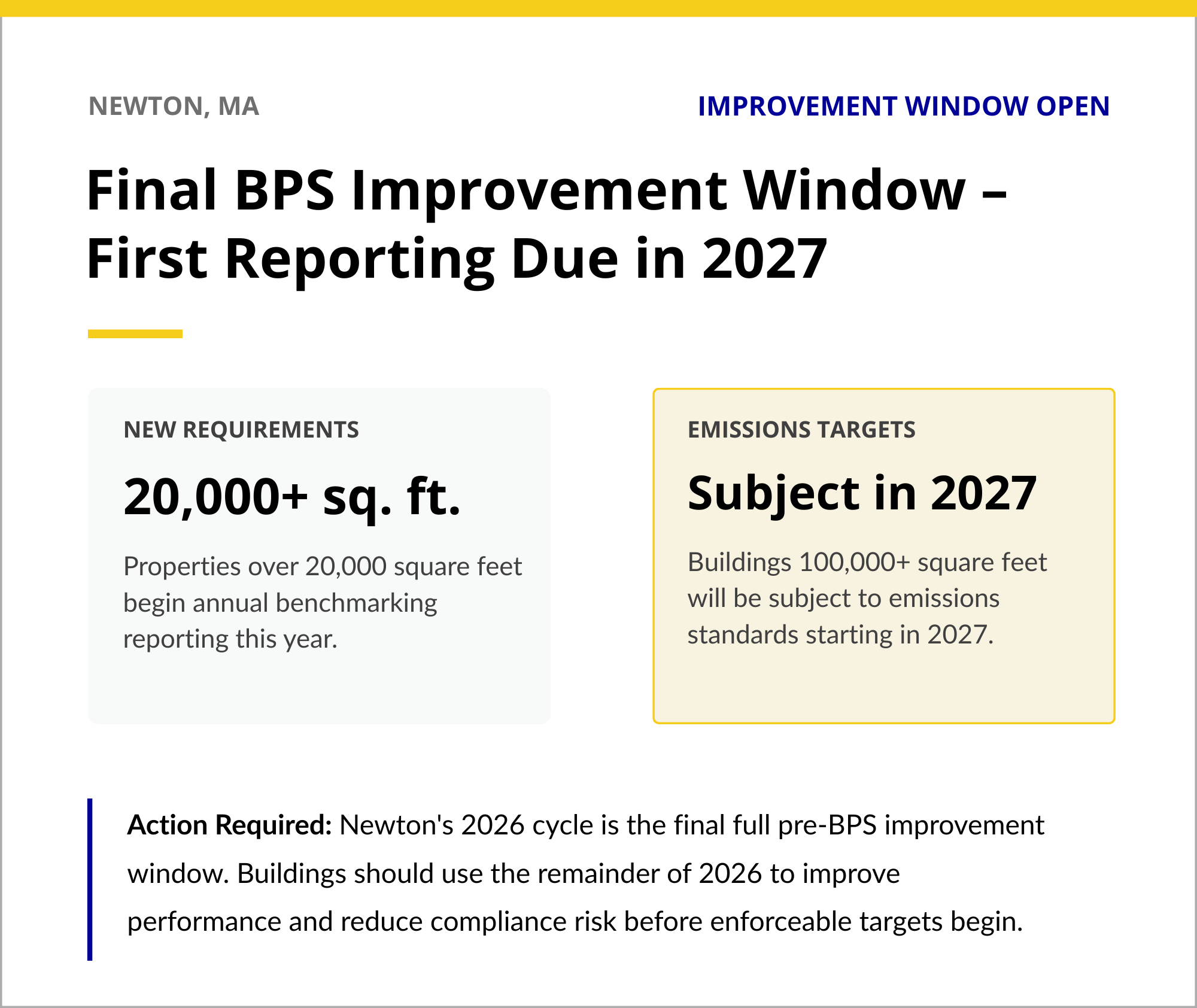
Newton's 2026 reporting cycle is the final full pre-BPS improvement window for many larger buildings. Properties over 20,000 square feet begin annual benchmarking reporting this year, and larger buildings 100,000+ square feet will be subject to emissions standards in 2027. Buildings should use the remainder of 2026 to improve performance and reduce compliance risk before enforceable targets begin.
Other Regulations
Building Tune-Ups For Building Performance
Regular maintenance and tune-ups keep building systems running efficiently and without waste. Jurisdictions with tune-up requirements generally schedule reporting later in the year so owners have time to perform the work. The programs below are in an active 2026 cycle.
BUILDING TUNE-UPS
Full YearData Verifications Required Across Many Jurisdictions
Accurate, verifiable data is what drives a building's assigned performance target and the improvements required to meet it. In 2026, several jurisdictions require buildings to submit third-party verification of 2025 data. These requirements continue well after benchmarking deadlines close and often feed directly into the June compliance wave. Touchstone IQ is qualified to conduct data verifications in all jurisdictions listed below.
DATA VERIFICATION
May – SeptEnergy Audits & Retro-Commissioning
Energy audits and retro-commissioning provide a detailed, investment-grade assessment of a building's energy performance and surface actionable efficiency measures. Retro-commissioning complements audits by systematically testing and tuning existing equipment and control sequences. Together, they help owners establish a clear baseline, prioritize conservation measures, and build a practical compliance plan. Owners with covered buildings in jurisdictions such as New York City, Washington, D.C., and Philadelphia should confirm 2026 audit and retro-commissioning obligations well ahead of their reporting year.
AUDITS & RETRO-COMMISSIONING
Full YearTOUCHSTONE IQ
⬡
TIQ
⬡
TOUCHSTONE IQ ⬡ TIQ ⬡
Touchstone in the Spotlight
A look at where the Touchstone IQ team has been engaging the building decarbonization community over the past month.

USGBC California Annual Conference · May 27, 2026
California Green Building Conference
Touchstone IQ Spoke at USGBC California
Touchstone IQ joined jurisdictions from across California at the USGBC-California annual conference, where CEO Jon Dierking and Director of Government Partnerships Kyle Ragan participated in sessions and conversations with some of the state's leading voices in sustainable building policy. This year's event made clear just how much momentum is building across the state.
It was gratifying to see the depth of leadership and vision that jurisdictions throughout California are bringing to this work, and a strong reminder of why our partnership with USGBC-CA is one we deeply value. Touchstone IQ looks forward to continuing to grow this collaboration as we collectively advance a greener, more resilient built environment.

Efficiency Exchange 2026 (EFX26) · Boise, ID
Efficiency Exchange 2026
Layering Software Turns Building Data Into Dollars
At Efficiency Exchange 2026 (EFX26) in Boise, Director of Business Development Ben Levine took the stage as a panelist in EUI Got This: Winning Technology Strategies for Building Performance. Ben brought forward messaging that every building owner wants to hear: stacking software technologies provides amplified value.
For owners facing benchmarking deadlines, performance standard targets, and climbing energy costs all in tandem, the path forward can feel like a wall of competing priorities. Ben lays out that the smartest approach isn’t to tackle everything at once – it’s to follow a sequenced layer of technologies where each layer makes the next stronger, beginning all with understanding your energy data.
Before committing a dollar to improvements, an owner needs to know exactly how each building is performing and which ones are quietly underperforming. Benchmarking and performance analytics turn a portfolio from a black box into a prioritized map, surfacing the buildings that are draining budgets and pinpointing where attention is needed most. Virtual commissioning – using software to detect faults and fine-tune how existing systems run – cuts energy and operating costs without major capital spending. Once a clean baseline is established and operational savings are flowing, owners are not positioned to invest with confidence.
Layered altogether, the effect compounds: data informs operations, operations fund capital, and capital unlocks performance gains that a single tool cannot accomplish on its own. With an amplified value of a connected approach, owners can develop the kind of strategy that can be put into motion every day.
TOUCHSTONE IQ
⬡
TIQ
⬡
TOUCHSTONE IQ ⬡ TIQ ⬡
Industry News
Southern California Celebrates First Equitable Building Decarbonization Project
This spring, the California Energy Commission (CEC) and Los Angeles County held a ribbon-cutting at McKinney Manor, an affordable housing community for low-income seniors in San Diego, to mark the first completed Southern California project under the CEC's Equitable Building Decarbonization (EBD) Program. Residents received efficient electric upgrades at no cost, trading aging, polluting appliances for modern technology like heat pump water heaters and induction cooktops. Established under Assembly Bill 209 and funded through California's Cap-and-Invest Program, the EBD Program replaces outdated equipment with clean electric equivalents in single-family, multifamily, and manufactured homes to cut energy costs and improve indoor air quality. It is rolling out region by region, administered by Los Angeles County in Southern California, the Center for Sustainable Energy in Central California, and the Association for Energy Affordability in the north. Eligibility depends on factors like home location, household income, building age, and current appliance type, ensuring the upgrades reach the households that benefit most. Owners and communities curious whether they qualify can find focus areas and full eligibility details on the California Energy Commission's EBD Program page.
Virginia Enacts First U.S. Law on Data-Center Waste-Heat Reuse
Virginia, the country’s largest data-center market, just became the first state to enact legislation on reusing waste heat from data centers (HB323, signed by Gov. Spanberger). The law directs the Department of Energy to build a strategic plan, convene an expert work group, and report back to the General Assembly by September 1, 2026. It’s early-stage by design, but it puts a replicable policy template on the table for a heat source that studies suggest could offset roughly 30% of nearby energy demand.
TOUCHSTONE IQ
⬡
⬡
TIQ
TOUCHSTONE IQ ⬡ ⬡ TIQ
Your 2026 Compliance Checklist
Need help with your building portfolio?
Touchstone IQ can confirm coverage, deadlines, and compliance for every property in your portfolio. Contact our team to see what we can do to help.
sales@touchstoneiq.com | 303-327-9769 | touchstoneiq.com