

TOUCH BASE : July 2026 Edition

2026 Energy Benchmarking & Building Performance Standards Deadlines
The majority of jurisdictions have now completed their 2026 energy benchmarking season! With only a few deadlines remaining for the year, our latest TouchBase looks at what remains ahead and how to begin planning the rest of your 2026 for your compliance efforts next year.
2026 By the Numbers
2026 compliance deadlines passed as of July 20, 2026 — 8 benchmarking and 1 BPS deadline still ahead.
Benchmarking
Energy Benchmarking Deadlines — Next 90 Days
Below are all the mandatory benchmarking deadline falling within the 90 days following this edition's July publication. Deadlines are grouped by reporting window, mirroring Touchstone IQ's 2026 deadlines list. Owners with properties in any jurisdiction below should confirm coverage, finalize data pulls, and line up third-party verification where required before the filing date.
Missed A Deadline? What Do You Do Now?
Energy benchmarking deadlines can be difficult to track throughout the course of the year. If you missed a deadline, many jurisdictions offer a 30 – 60 day post deadline extension request, in which buildings may apply to receive an extension to submit their annual benchmarking reporting. Although, with many extension deadlines having passed, a tailored approach to a jurisdiction is needed in order to navigate remaining benchmarking submission issues. Touchstone IQ can assist you in achieving compliance and resolving any key issues that linger for your building by working with a jurisdiction.
Remaining Jurisdictions
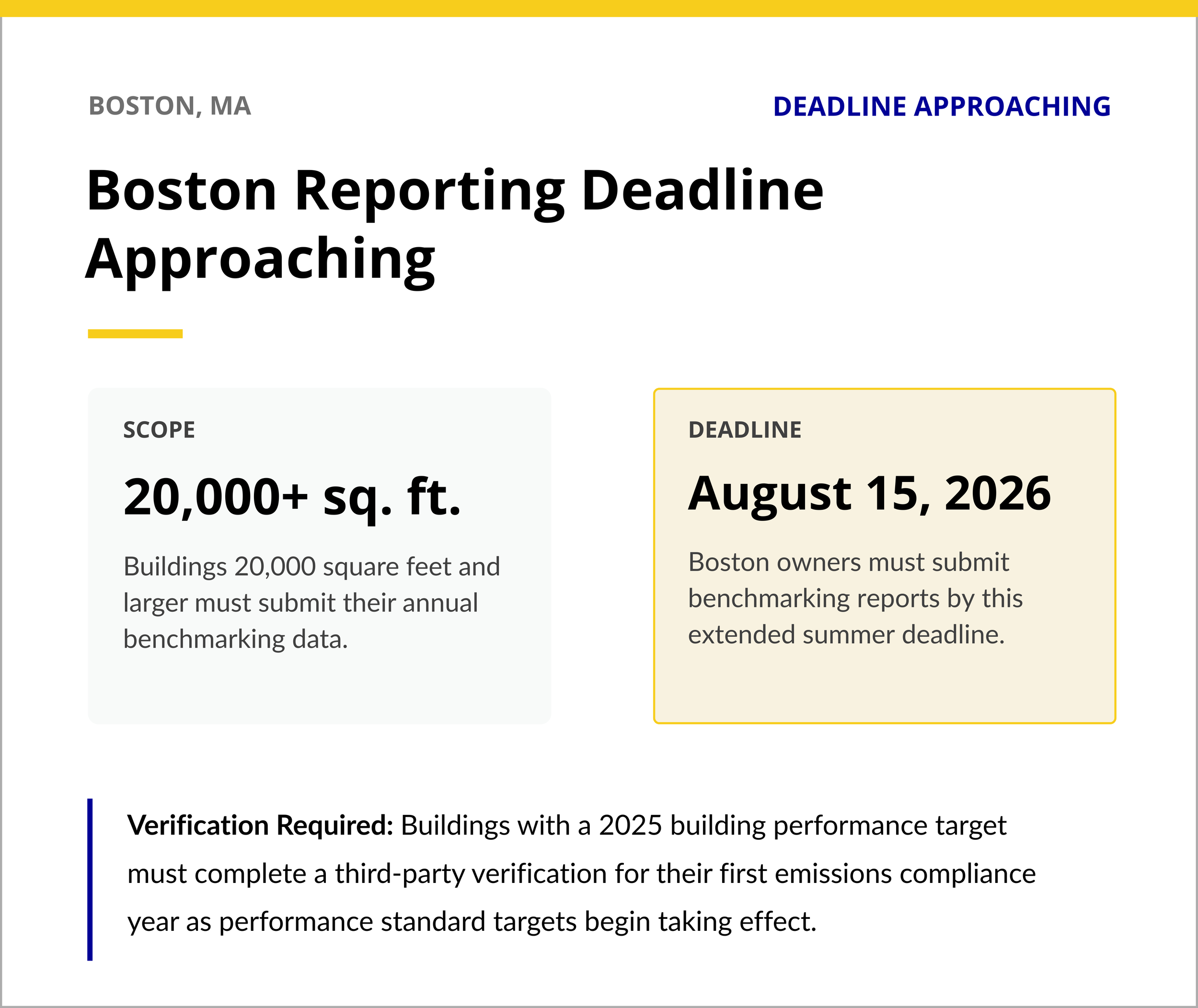
Boston owners must submit their benchmarking data by the extended reporting deadline of August 15th, 2026. Buildings 20,000 square feet and larger must report their benchmarking data and certain buildings have begun to comply with building performance standard targets. Additionally, buildings must complete a third-party verification for their first emissions compliance year if they had a 2025 building performance target.
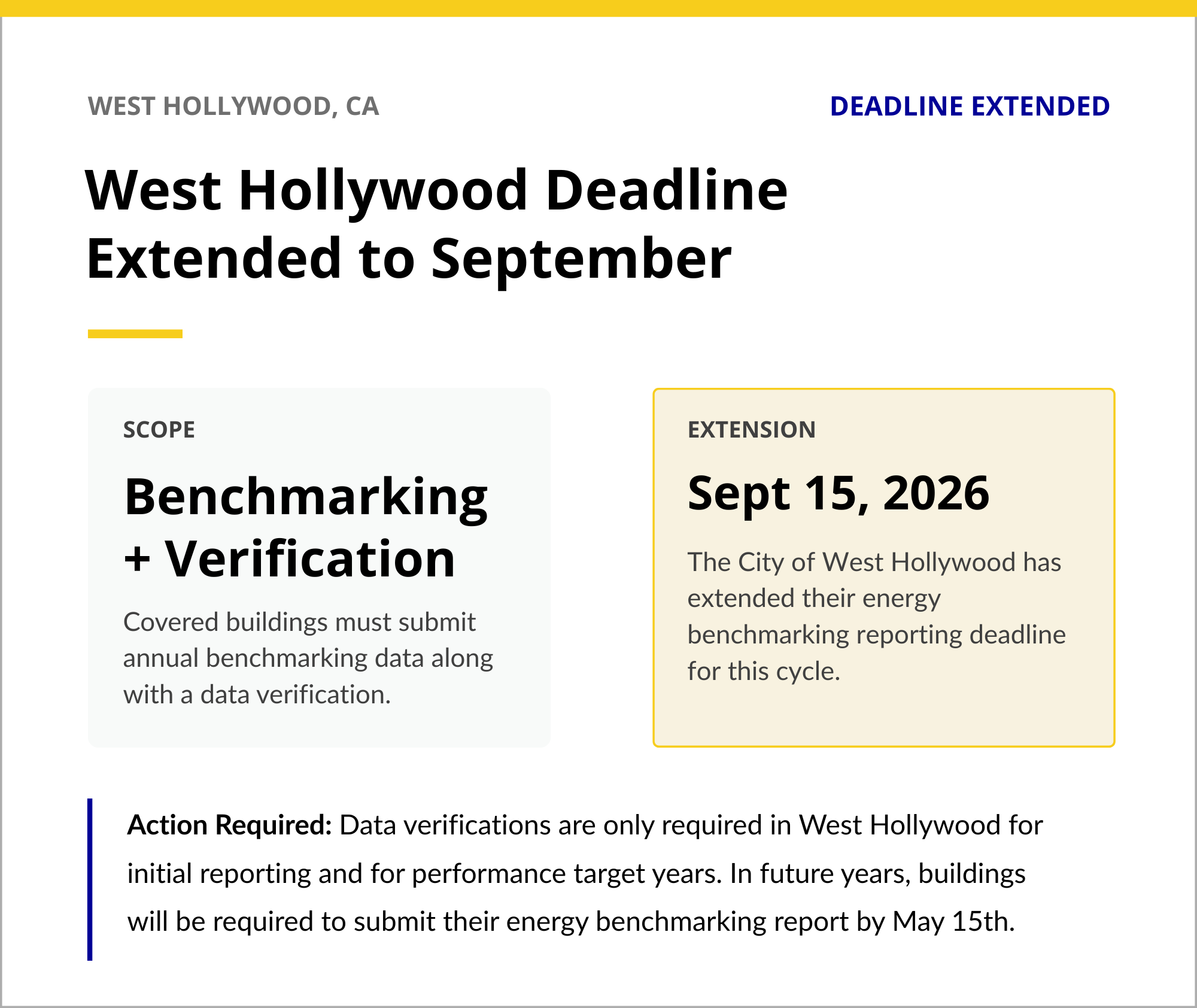
West Hollywood
The City of West Hollywood has extended their energy benchmarking reporting deadline to September 15th, 2026. Covered buildings must submit annual benchmarking data along with a data verification. In future years, buildings will be required to submit their energy benchmarking report by May 15th. Data verifications are only required in West Hollywood for initial reporting and for performance target years.
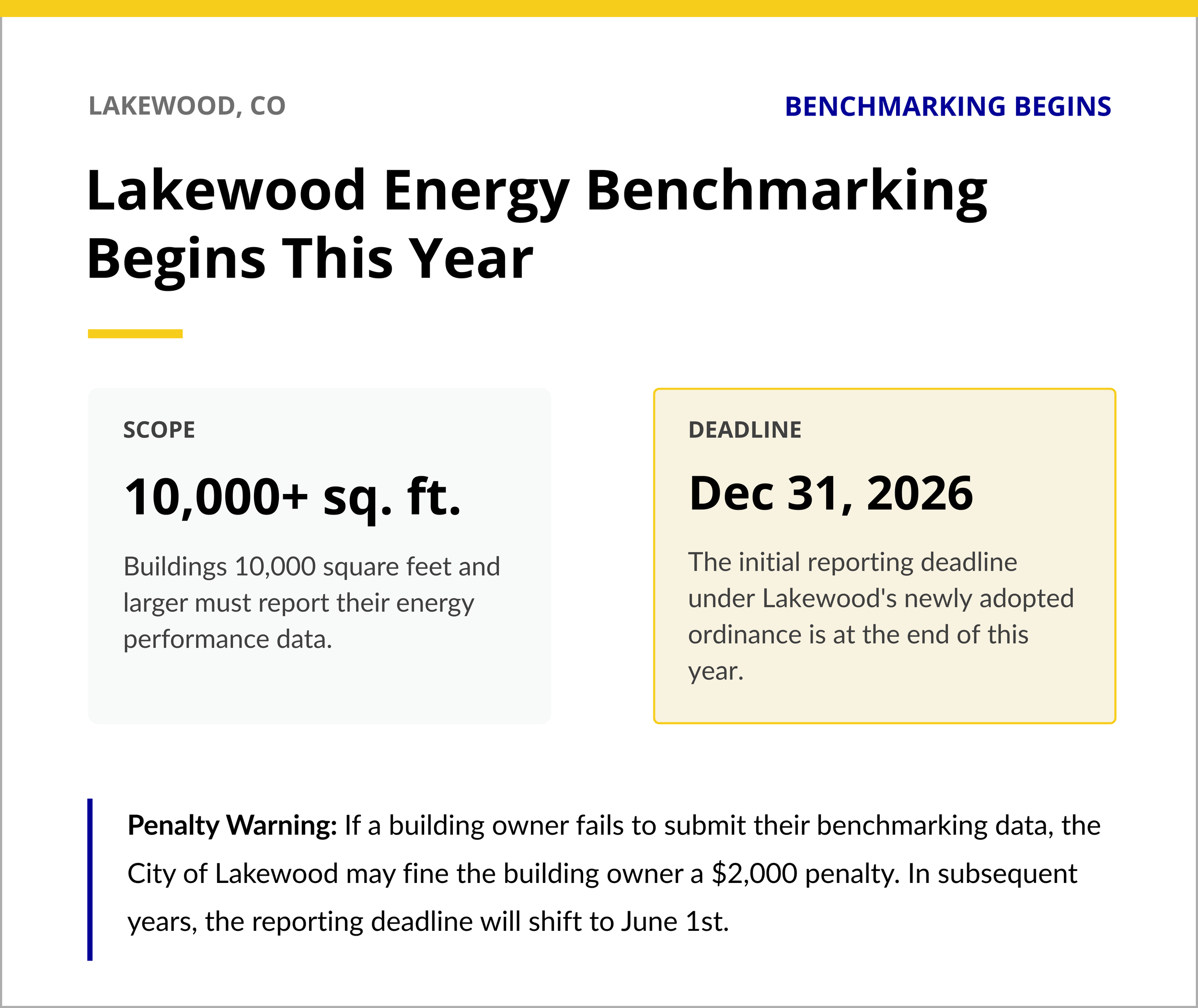
Adopted earlier this year, the City of Lakewood, Colorado has adopted their own Energy Benchmarking ordinance. Buildings 10,000 square feet and larger must report their energy data by December 31st, 2026. In subsequent years, buildings must report by 2027. If a building owner fails to submit their benchmarking data, the City of Lakewood may fine the building owner a $2,000 penalty.
2026 Building Performance Standards (BPS) Targets
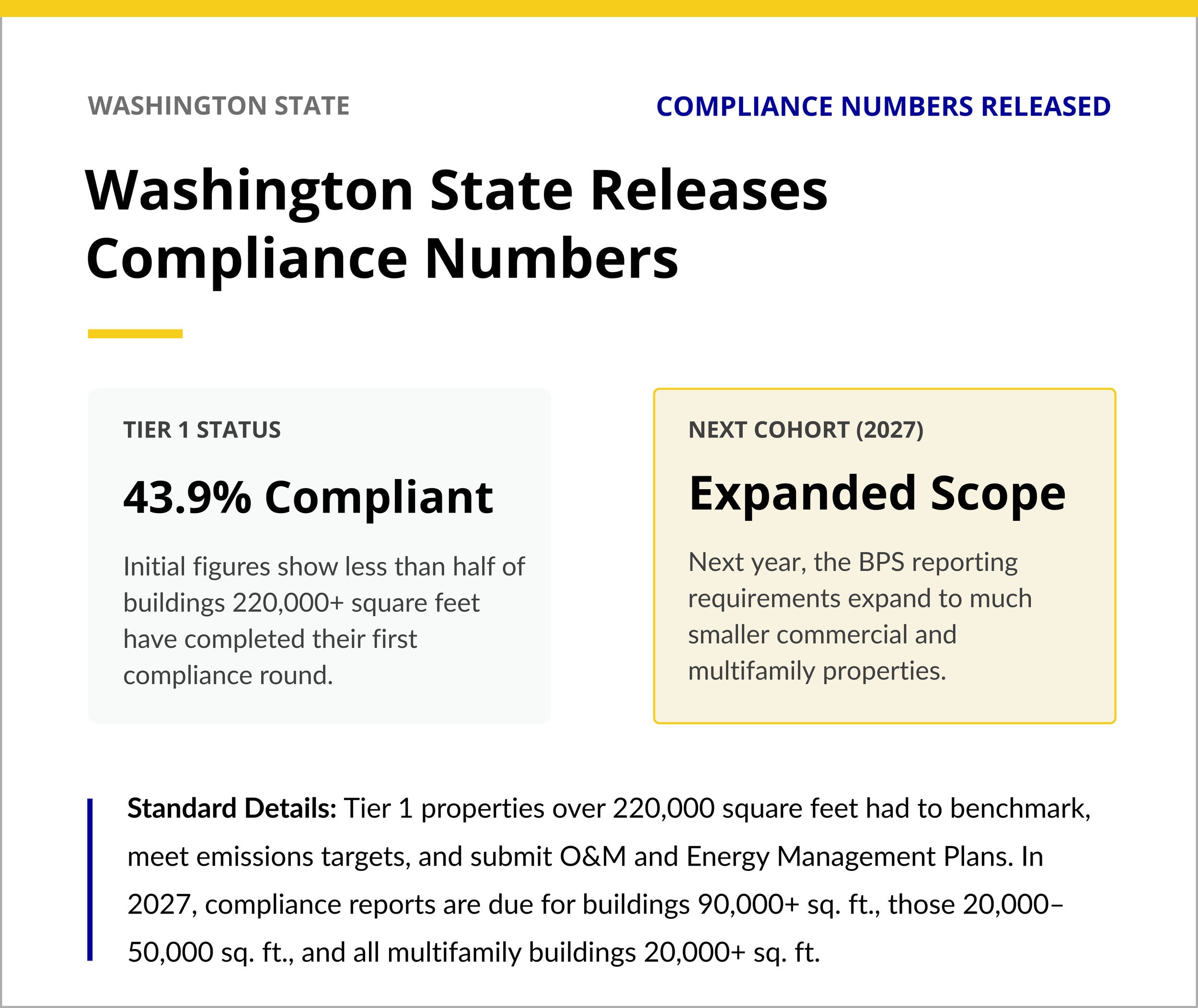
Washington State
Washington State's Clean Buildings Performance Standard is the most recent example of a major jurisdiction completing their first cohort of BPS compliance. Tier 1 buildings over 220,000 square feet had to complete benchmarking, achieve their emissions target and submit required compliance materials, such as an Operations and Maintenance program and an Energy Management Plan. Washington State has released their initial compliance figures with 43.9% of buildings 220,000 square feet or larger having achieved compliance with the BPS program. Next year in 2027, buildings 90,000 square feet or larger, 20,000 – 50,000 square feet, and all multifamily 20,000 square feet or larger will have to report BPS compliance with Washington.
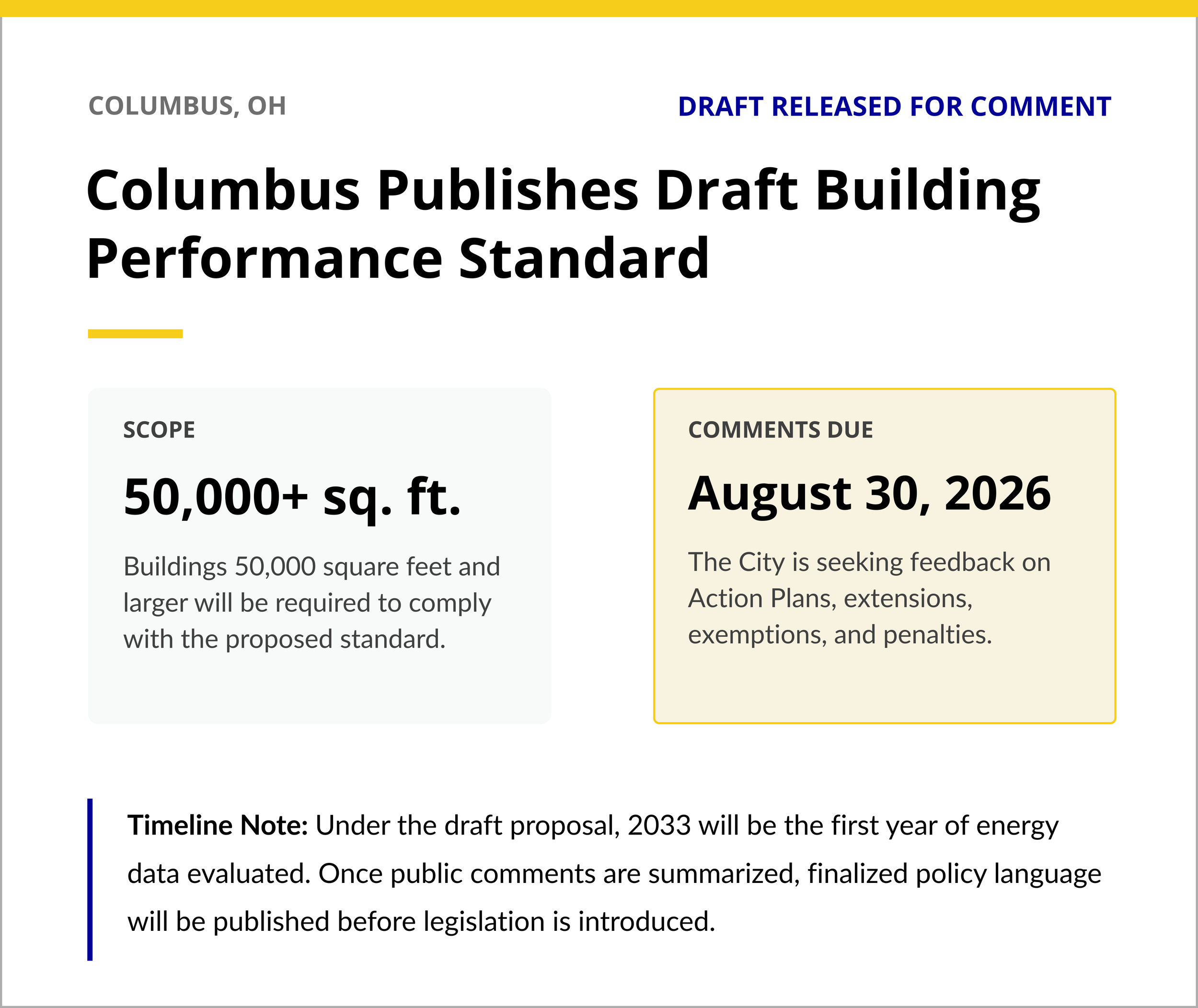
The City of Columbus has released a draft of their Building Performance Standard for public comment, with comments due August 30th, 2026. Buildings 50,000 square feet and larger are to comply with the BPS and will have 2033 be the first year of energy data that is evaluated. The City of Columbus is seeking comment on different aspects of the draft BPS such as Building Performance Action Plans, extensions, exemptions, and penalties. Once the city has summarized public comment feedback, the finalized policy language will be published before legislation is passed to adopt the policy.
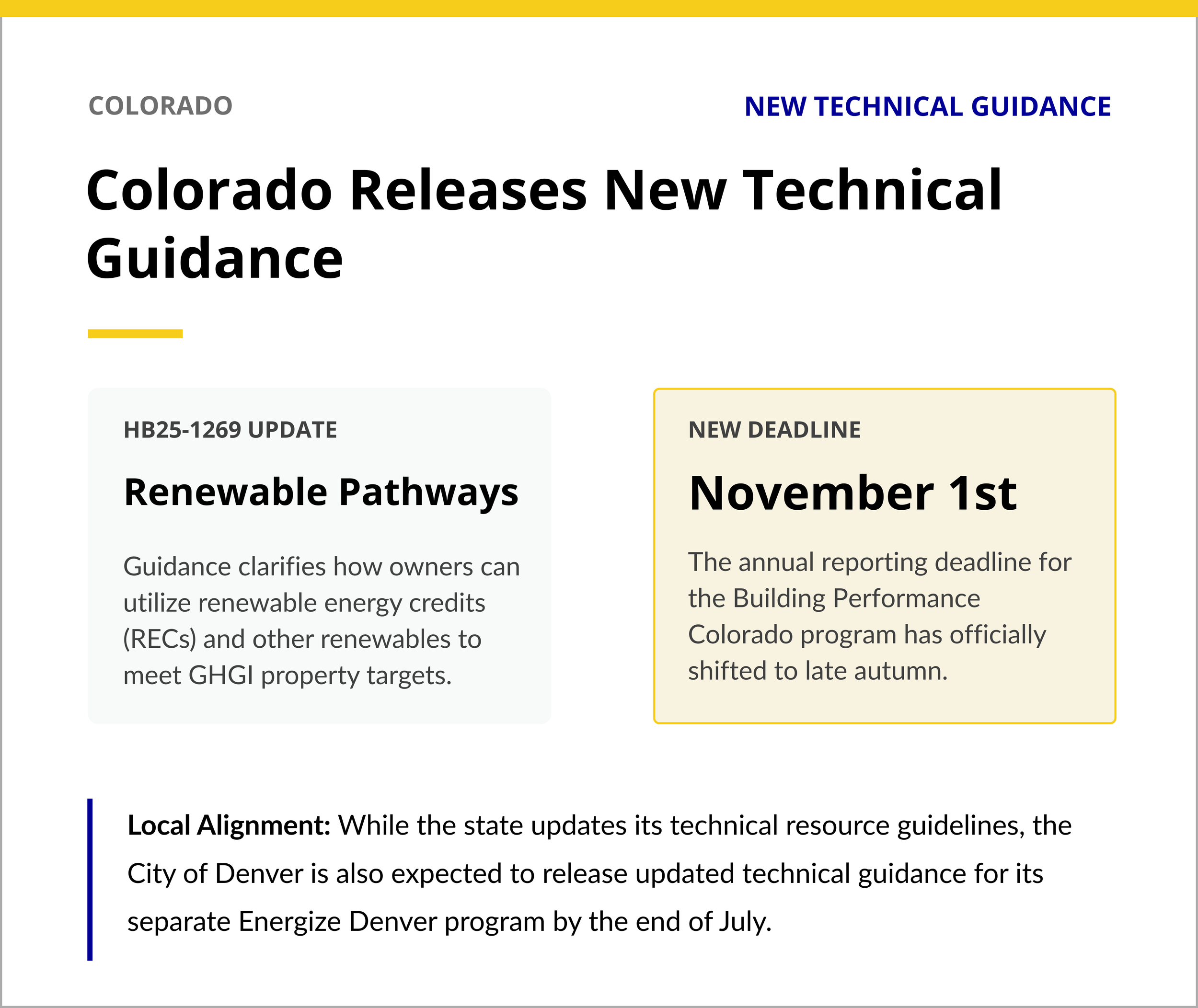
Colorado has released the latest version of their Building Performance program’s Technical Guidance. The document provides the most up-to-date resource for building owners to understand the building performance requirements in Colorado. In 2025, Colorado passed HB25-1269 which included major updates to the Building Performance Colorado program. The new annual reporting deadline for Colorado is November 1st. Additionally, Colorado provided clarification and guidance in how building owners can utilize renewable energy credits and other renewables to achieve their GHGI property type target. The City of Denver is also expected to release updated technical guidance for the Energize Denver program by the end of July.
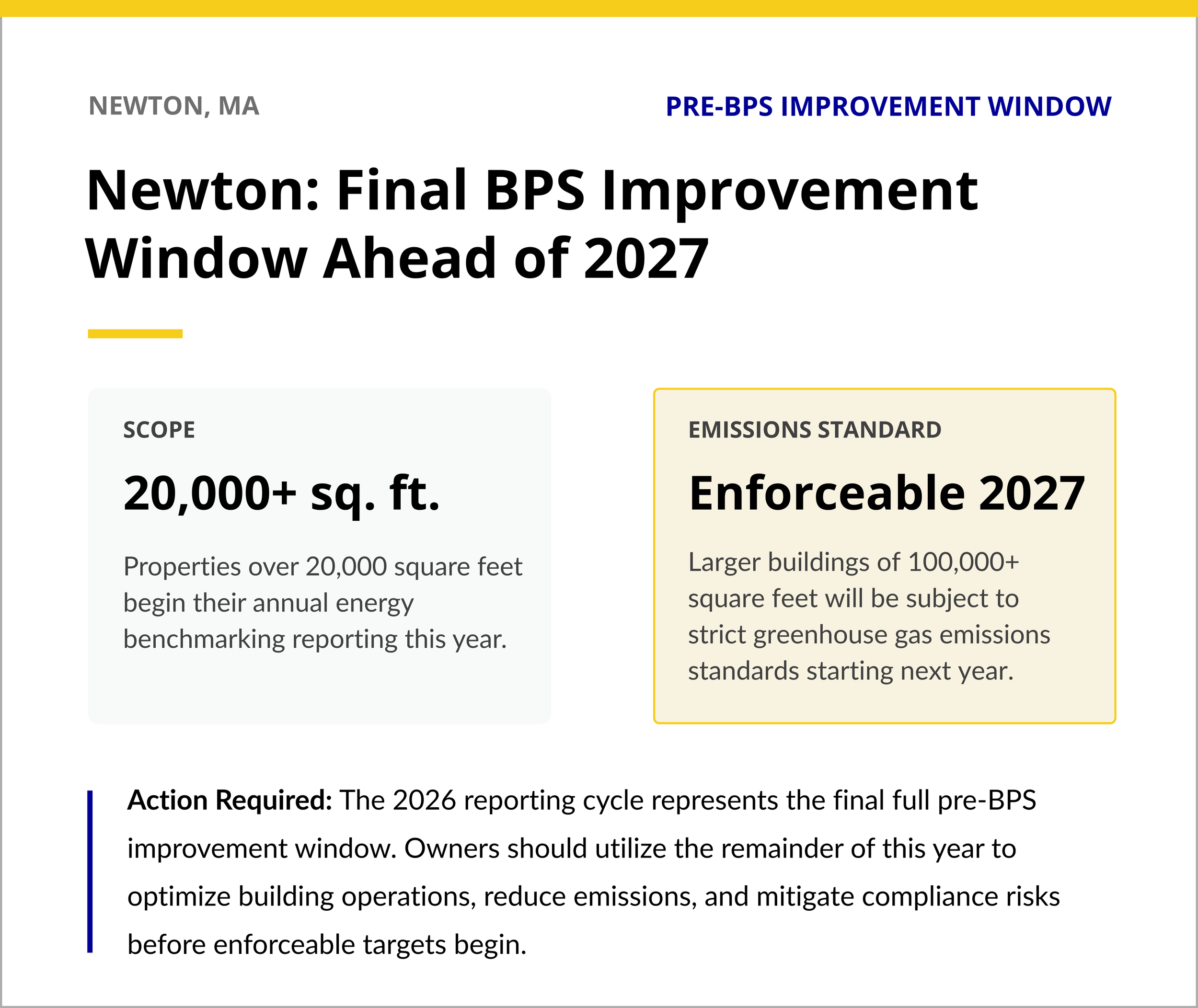
Newton's 2026 reporting cycle is the final full pre-BPS improvement window for many larger buildings. Properties over 20,000 square feet begin annual benchmarking reporting this year, and larger buildings 100,000+ square feet will be subject to emissions standards in 2027. Buildings should use the remainder of 2026 to improve performance and reduce compliance risk before enforceable targets begin.
Other Regulations
Building Tune-Ups For Building Performance
Regular maintenance and tune-ups keep building systems running efficiently and without waste. Jurisdictions with tune-up requirements generally schedule reporting later in the year so owners have time to perform the work. The programs below are in an active 2026 cycle.
BUILDING TUNE-UPS
Full YearData Verifications Required Across Many Jurisdictions
Accurate, verifiable data is what drives a building's assigned performance target and the improvements required to meet it. In 2026, several jurisdictions require buildings to submit third-party verification of 2025 data. These requirements continue well after benchmarking deadlines close and often feed directly into the June compliance wave. Touchstone IQ is qualified to conduct data verifications in all jurisdictions listed below.
DATA VERIFICATION
May – SeptEnergy Audits & Retro-Commissioning
Energy audits and retro-commissioning provide a detailed, investment-grade assessment of a building's energy performance and surface actionable efficiency measures. Retro-commissioning complements audits by systematically testing and tuning existing equipment and control sequences. Together, they help owners establish a clear baseline, prioritize conservation measures, and build a practical compliance plan. Owners with covered buildings in jurisdictions such as New York City, Washington, D.C., and Philadelphia should confirm 2026 audit and retro-commissioning obligations well ahead of their reporting year.
AUDITS & RETRO-COMMISSIONING
Full YearTOUCHSTONE IQ
⬡
TIQ
⬡
TOUCHSTONE IQ ⬡ TIQ ⬡
Touchstone in the Spotlight
A look at where the Touchstone IQ team has been engaging the building decarbonization community over the past month.

IMN's ESG & Decarbonizing Real Estate Summer · California · July 15, 2026
IMN’S ESG & Decarbonizing Real Estate Summer
Touchstone IQ CEO Jon Dierking joined a panel discussion on building performance data, benchmarking, and reporting at IMN’s ESG and Decarbonizing Real Estate Summer in California. The discussion tackled the hardest questions building owners are dealing with right now: how do you collect, manage, and use building-level data across energy and water in a way that holds up to scrutinized pressure. At a time when building owners are under pressure at meeting performance requirements, but also data scrutiny from investors, lenders, and regulators, it is important to understand how better data is obtained and used to inform real operational and capital decisions. This year’s event has made clear how important it is to not only correctly collect your data but also understanding your data in the face of data scrutiny.
TOUCHSTONE IQ
⬡
TIQ
⬡
TOUCHSTONE IQ ⬡ TIQ ⬡
Industry News
Southern California Celebrates First Equitable Building Decarbonization Project
A major federal incentive for energy-efficient commercial building upgrades has closed out. Section 179D of the Internal Revenue Code — which offered building owners a deduction of up to $5.81 per square foot for qualifying HVAC, lighting, hot water, and envelope improvements — no longer applies to projects that began construction after June 30, 2026, under a termination provision added by the One Big Beautiful Bill Act. Projects that broke ground on or before that date remain eligible even if they're placed in service later, but anything starting construction now falls outside the deduction entirely.
For owners who were pairing benchmarking-driven capital upgrades with 179D savings, this changes the math on new projects going forward. Anything already underway should have construction-start documentation and third-party certification confirmed now — the deduction requires a qualified, independent energy study regardless of when the sunset hits. Consult a tax advisor to confirm how the change affects any project currently in planning.
New NAIOP Research: Climate Risk Is Reshaping CRE Investment and Insurance
A new report report the NAIOP Research Foundation puts data behind a trend building owners have been feeling for years: physical climate risk is now a direct input into how commercial real estate gets financed, insured, and developed. Drawing on interviews with corporate occupiers, investors, developers, and architects across the industry, its core finding is that institutional investors, lenders, and insurers are increasingly building forward-looking physical risk analytics into underwriting, layering that on top of historical loss data and engineering-based resilience assessments.
For building owners, the report points to a widening gap between properties that invest in resilience and those that don't. Rising insurance premiums, tighter lender scrutiny, and evolving building codes are pushing the industry toward risk mitigation faster than return-on-investment alone would justify — but the report also notes that many owners still only invest in resilience when pushed by tenant requirements or institutional buyer expectations. For portfolios already tracking benchmarking and performance data, that same data increasingly doubles as the evidence lenders and insurers are asking for.
TOUCHSTONE IQ
⬡
⬡
TIQ
TOUCHSTONE IQ ⬡ ⬡ TIQ
Your 2026 Compliance Checklist
Need help with your building portfolio?
Touchstone IQ can confirm coverage, deadlines, and compliance for every property in your portfolio. Contact our team to see what we can do to help.
sales@touchstoneiq.com | 303-327-9769 | touchstoneiq.com