

TOUCH BASE : May 2026 Edition

2026 Energy Benchmarking & Building Performance Standards Deadlines
Twenty-four jurisdictions have June 1 deadlines — led by Washington State's Clean Buildings Performance Standard — and the window to prepare is closing fast. This edition of Touch Base recaps what closed, what is still open in May, and what building owners should be preparing for next.
2026 By the Numbers
2026 compliance deadlines passed as of May 8, 2026 — 53 benchmarking and 2 BPS deadlines still ahead
Benchmarking
Energy Benchmarking Deadlines - Next 90 Days
Below are all the mandatory benchmarking deadline falling within the 90 days following this edition's May 8 publication date. Deadlines are grouped by reporting window, mirroring Touchstone IQ's 2026 deadlines list. Owners with properties in any jurisdiction below should confirm coverage, finalize data pulls, and line up third-party verification where required before the filing date.
Group 1 | Remainder of May
Group 2 | June
Boston, MA
BERDO Reporting Deadline Extended to August
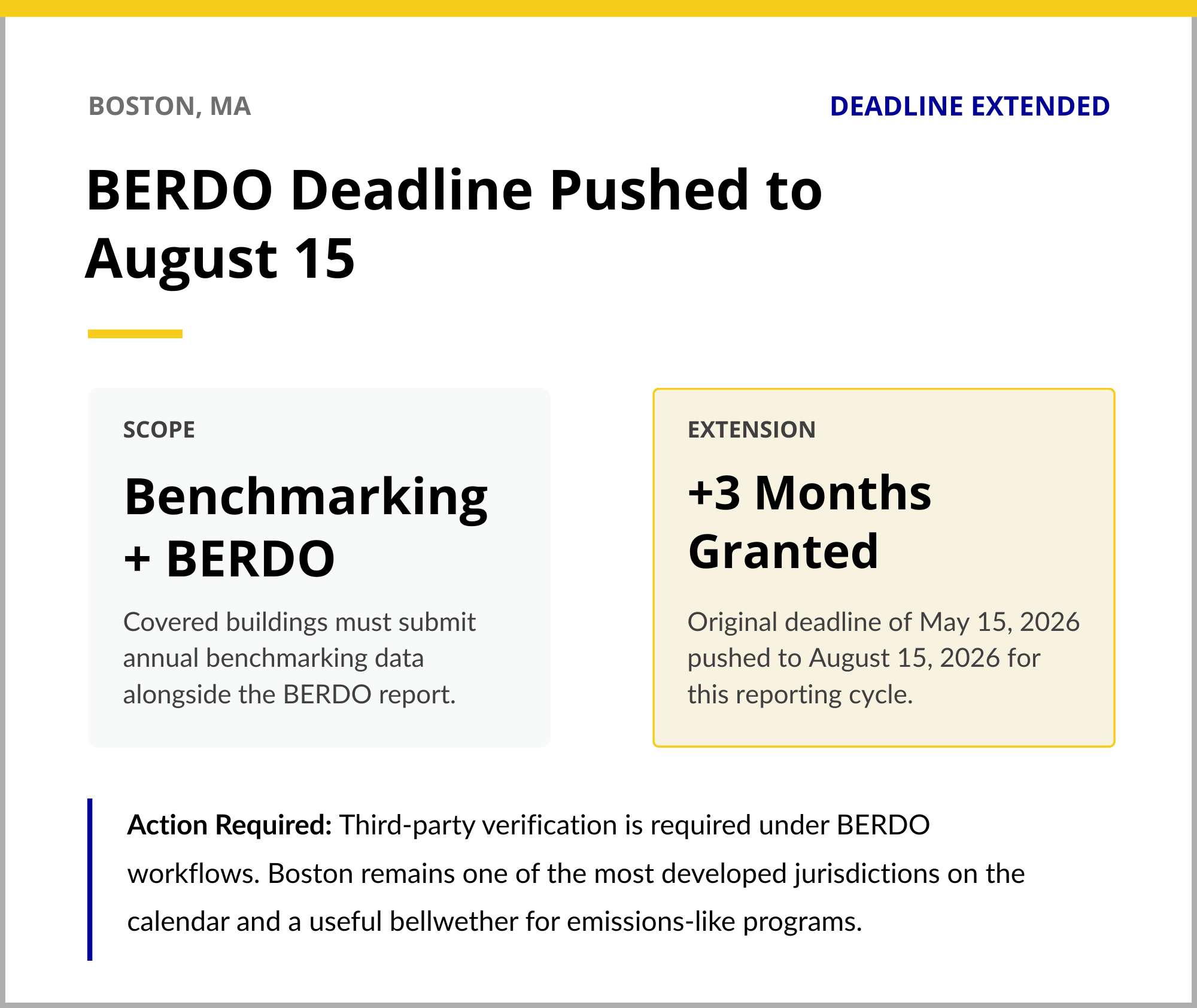
Boston owners have had their reporting deadline extended from May 15, 2026, to August 15th, 2026 for the benchmarking and BERDO reporting cycle. Covered buildings must submit annual benchmarking data along with the BERDO report, and third-party verification is required under BERDO workflows. Boston is one of the most developed jurisdictions on the calendar and a useful bellwether for how emissions-linked programs are maturing alongside traditional benchmarking.
Providence, RI
Small Buildings Now Covered
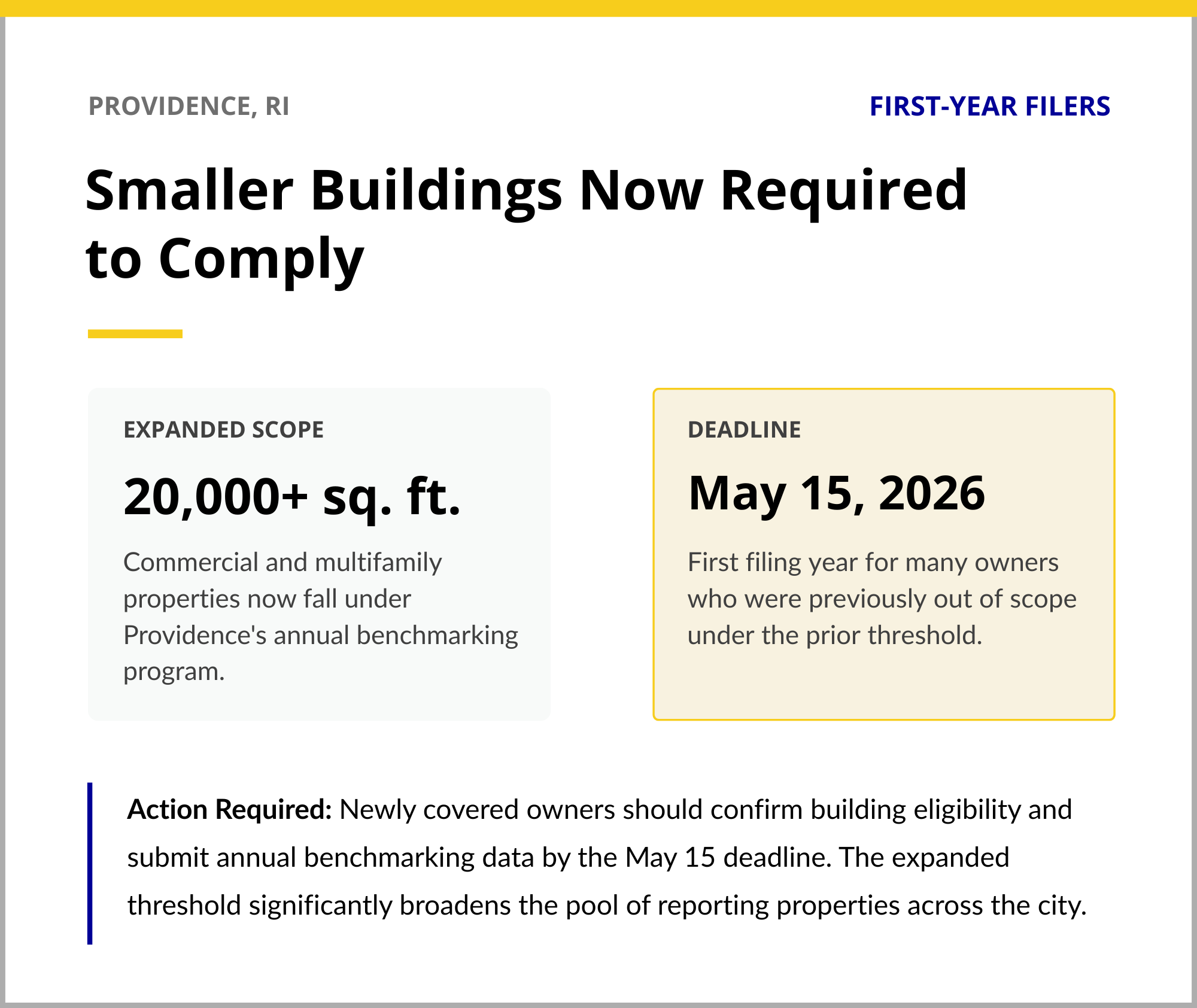
Providence is expanding its benchmarking program in 2026 to include smaller covered buildings that are 20,000+ square feet, with a May 15 reporting deadline. This extends annual reporting to a much broader pool of commercial and multifamily properties and makes 2026 a first-filing year for many owners who were previously out of scope.
New Orleans, LA
First Mandatory Benchmarking Cycle
— May 31 Deadline
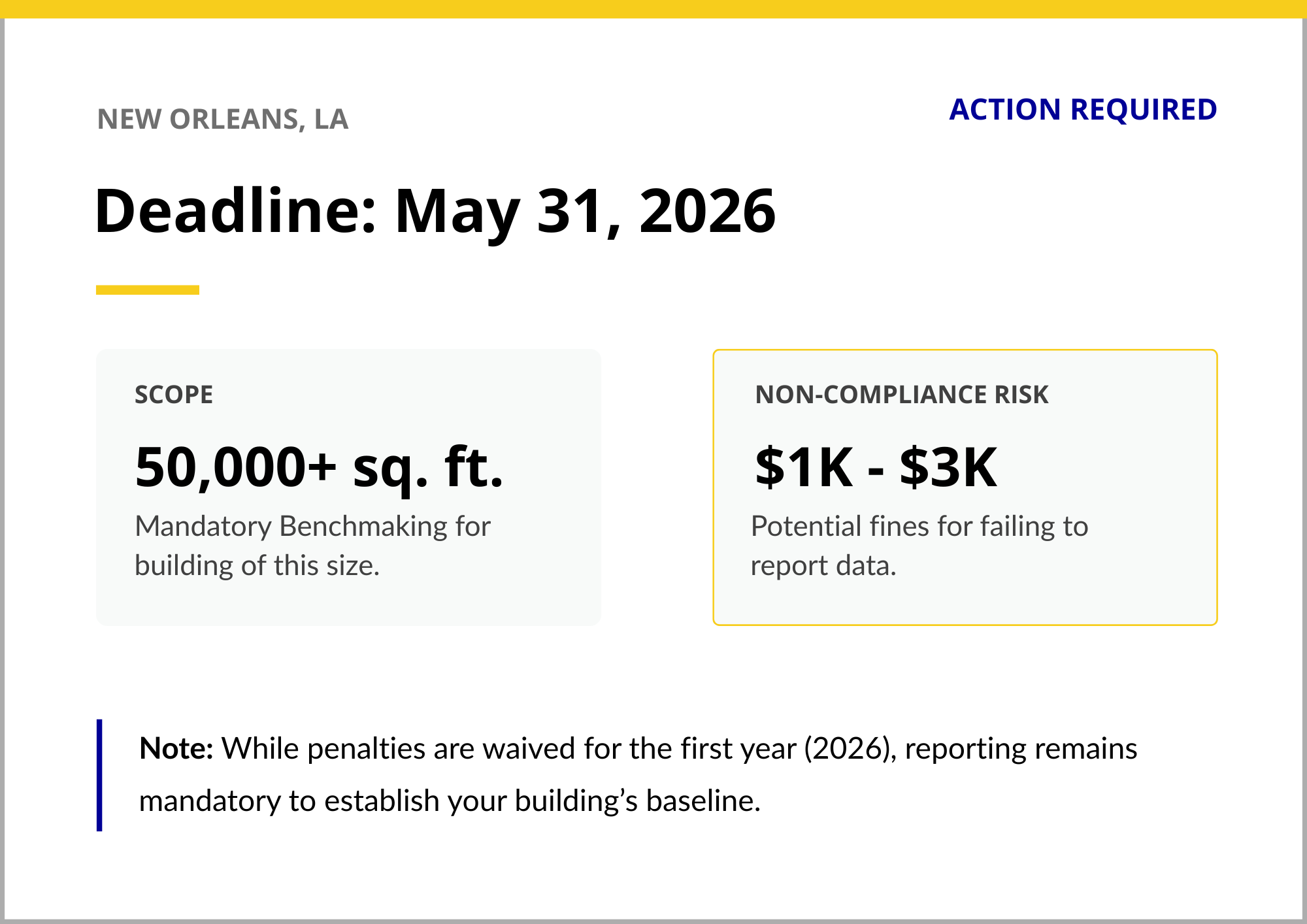
New Orleans's new mandatory energy benchmarking ordinance requires covered buildings 50,000 square feet or larger to submit benchmarking data by May 31, 2026. This is the city's first mandatory benchmarking cycle for large commercial and multifamily properties. Although first-year enforcement is structured to phase in gradually, owners should treat 2026 as the year to establish clean data and a repeatable reporting process.
Minnesota State
Large Building Benchmarking Expansion
— June 1
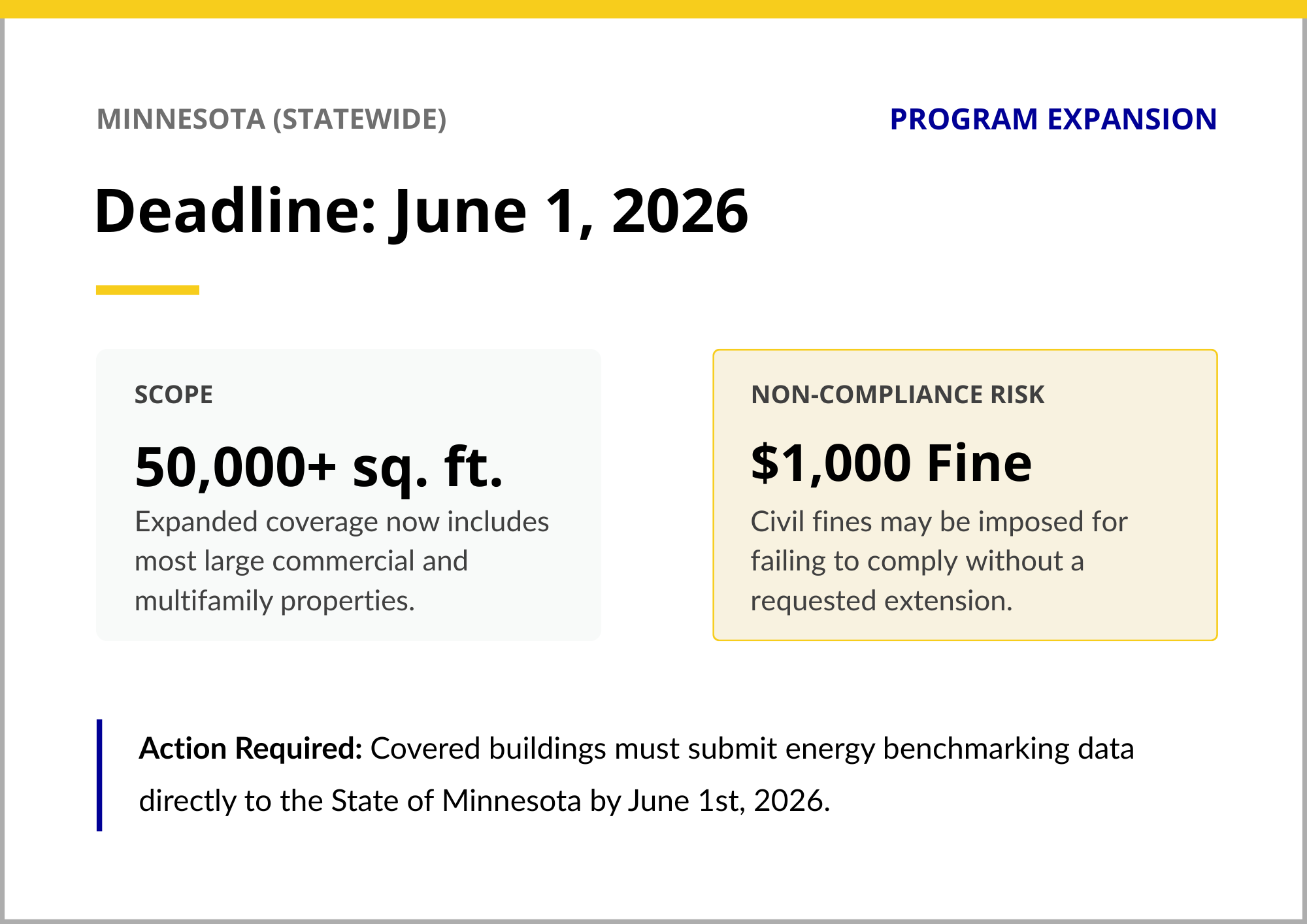
Minnesota's statewide benchmarking program expands in 2026 to cover buildings 50,000 square feet and larger in covered geographies, with annual reporting due to the state by June 1. This brings a large group of commercial and multifamily properties into mandatory reporting for the first time. Buildings in cities with fewer than 50,000 residents are exempt.
2026 Building Performance Standards (BPS) Targets

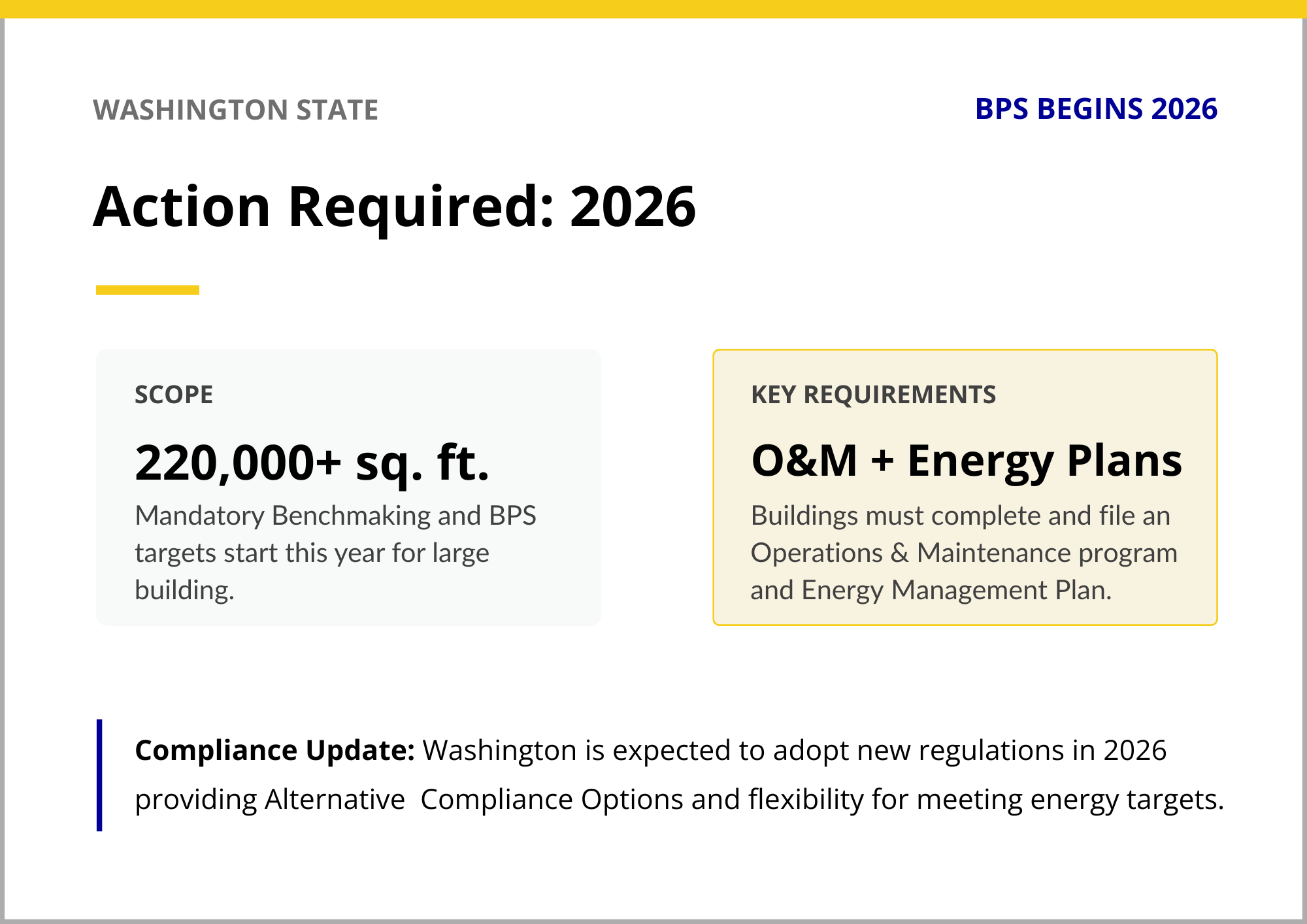
Washington State
BPS Begins This Year
— June 1 Milestone Ahead
Washington State's Clean Buildings Performance Standard is the clearest example of a major upcoming June 1, 2026, compliance milestone. Tier 1 buildings over 220,000 square feet must complete benchmarking, achieve their emissions target and submit required compliance materials, such as an Operations and Maintenance program and an Energy Management Plan. Washington State had begun the process to update their BPS regulations in 2025, but these updates are not expected to take effect until after the reporting deadline.
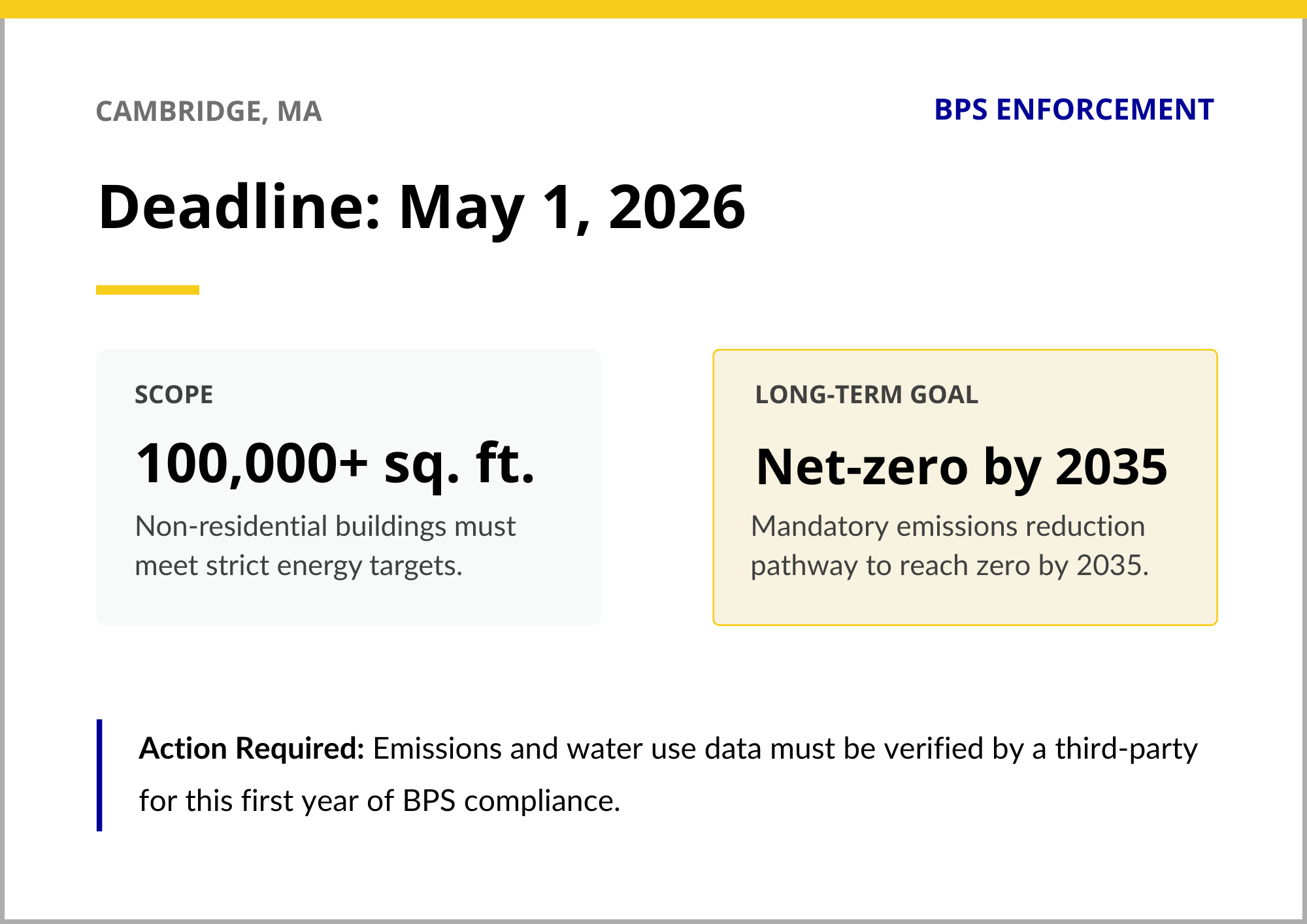
Cambridge, MA
2026 Target Reporting Year
— May 1 Deadline Completed
Cambridge closed its May 1, 2026, reporting deadline for covered buildings under the Building Energy Use Disclosure Ordinance. For large non-residential buildings, 2026 is both a completed spring reporting milestone and a first BPS target year, with the City requiring 2025 performance data and third-party verification as part of first-year compliance workflows. Cambridge is a strong example of a program that has already finished reporting while still carrying meaningful performance obligations for the remainder of the year.
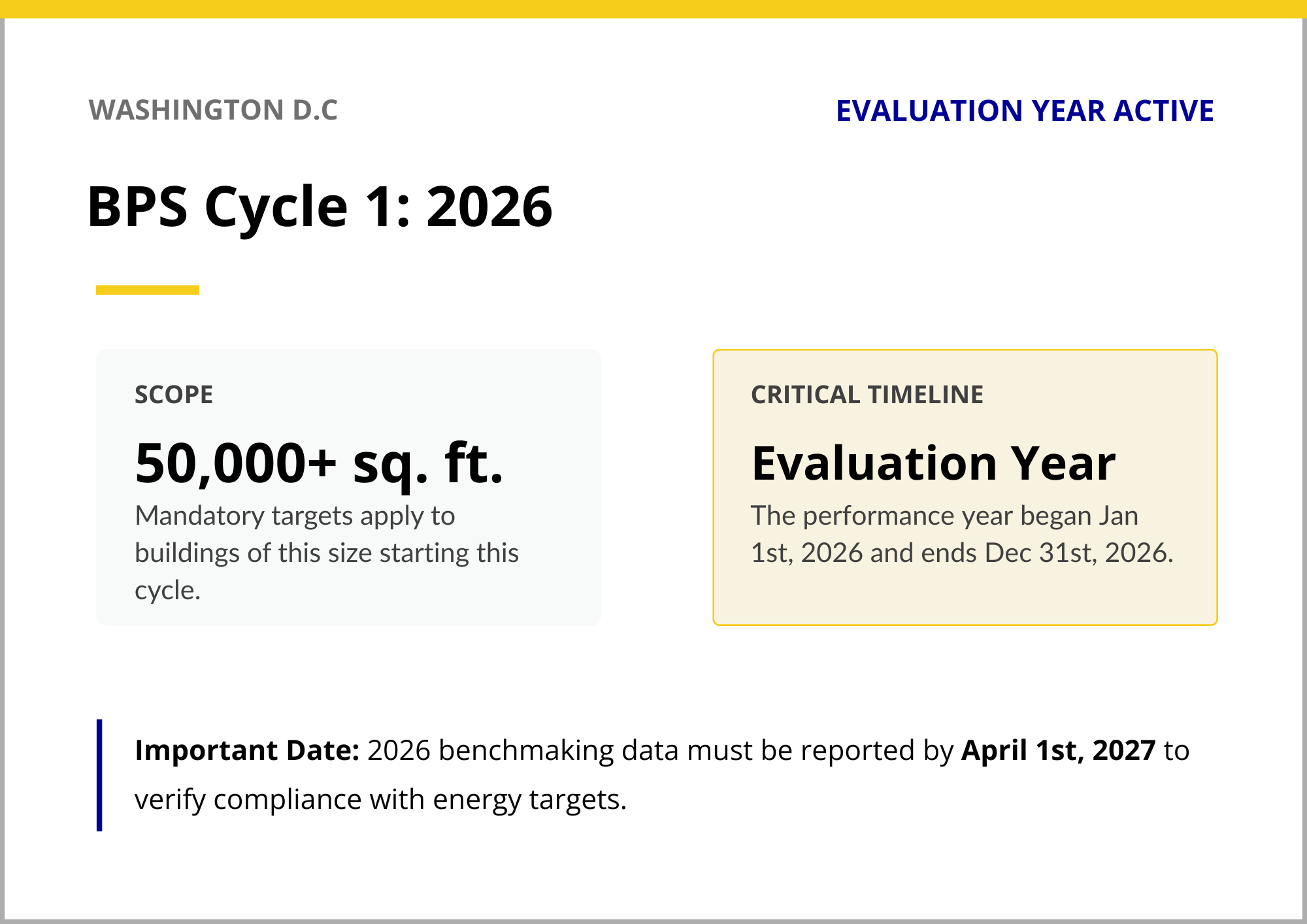
Washington D.C.
2026 BEPS Evaluation Year — First Reporting Due in 2027
Washington, D.C.'s May 1, 2026, deadline was an annual benchmarking filing, not a BEPS reporting milestone. The District's first BEPS compliance cycle ends December 31, 2026, and DOEE will evaluate covered buildings in 2027 based on the 2026 benchmarking report due May 1, 2027. That makes the remainder of 2026 the critical measurement window for owners on the performance pathway: operating data captured this year is what DOEE will use to determine whether a building meets its assigned standard.
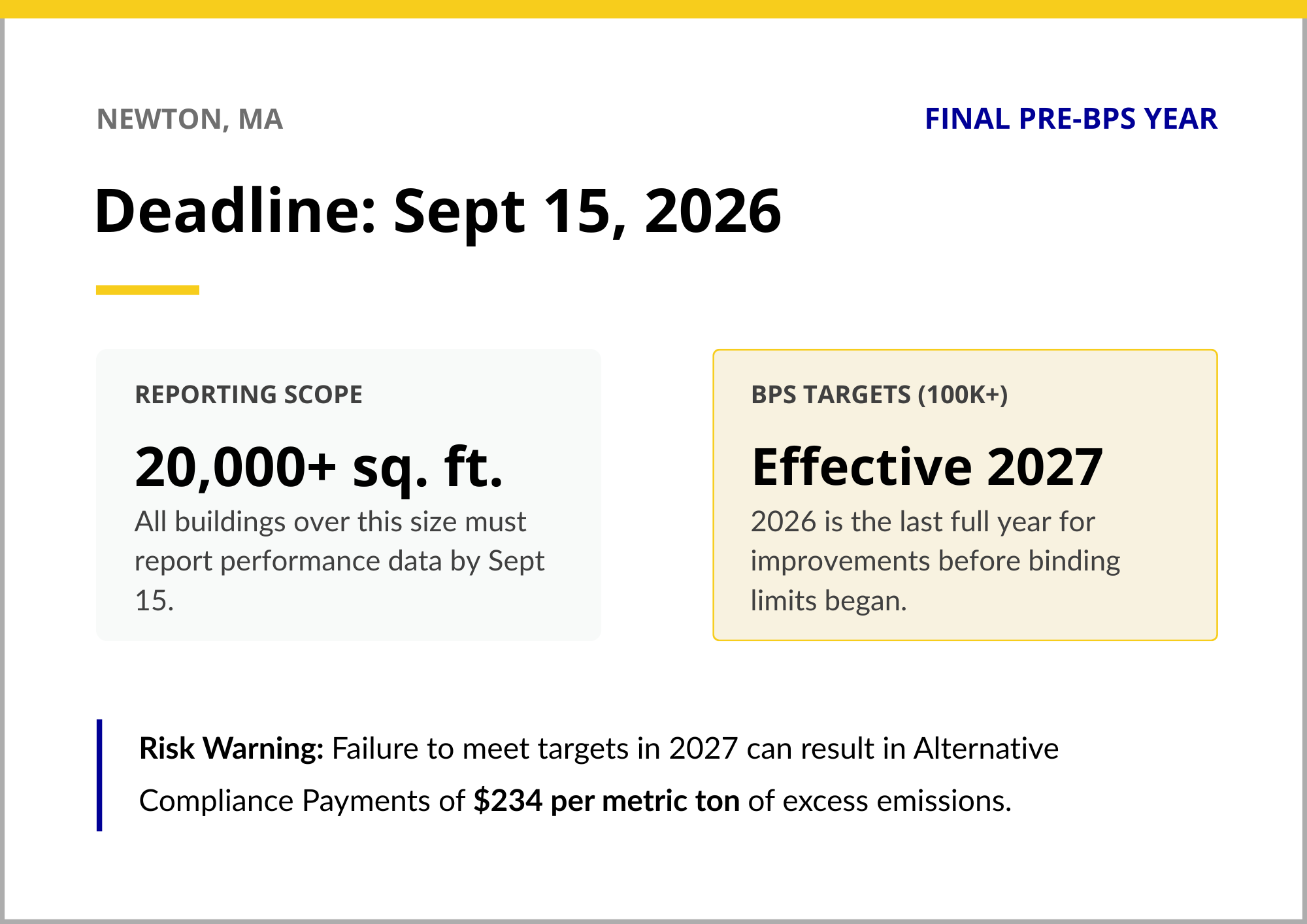
Newton, MA
Final BPS Improvement Window
— First Reporting Due in 2027
Newton's 2026 reporting cycle is the final full pre-BPS improvement window for many larger buildings. Properties over 20,000 square feet begin annual benchmarking reporting this year, and larger buildings 100,000+ square feet will be subject to emissions standards in 2027. Buildings should use the remainder of 2026 to improve performance and reduce compliance risk before enforceable targets begin.
Denver, CO
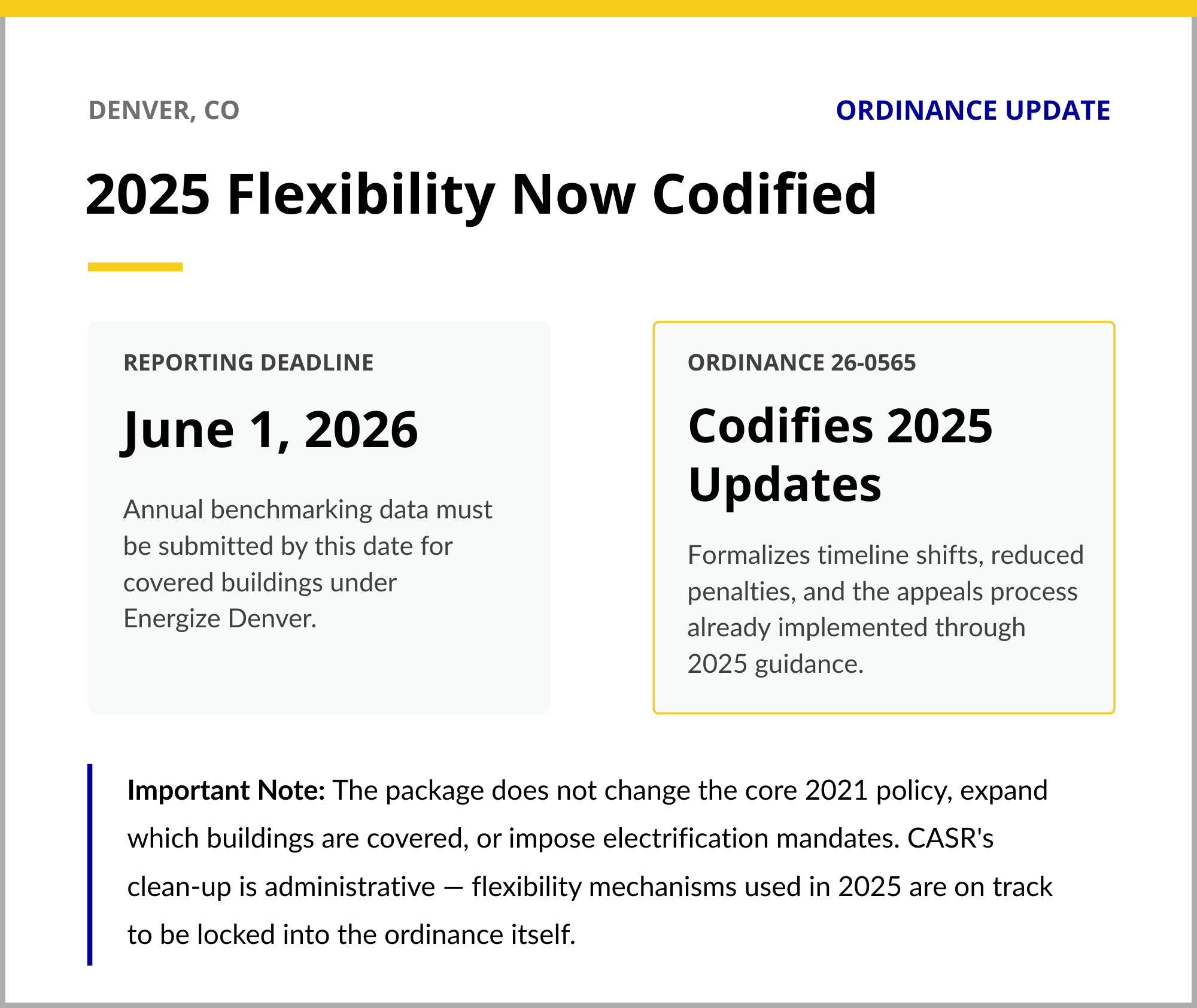
Proposed Ordinance Clean-Up Codifies 2025 Flexibility — June 1 Reporting Still On
Denver's Office of Climate Action, Sustainability and Resiliency (CASR) has introduced Ordinance 26-0565, a proposed clean-up of the Energize Denver Building Performance Policy that wraps up a multi-year stakeholder refinement process. The amendments are administrative: they codify timeline and penalty changes already implemented through 2025 rule and guidance updates, formalize benchmarking extension and baseline year adjustment processes, and shift the first large-building target year from 2024 to 2025 — a timeline extension 98.5% of covered buildings had already earned. Other updates clarify the covered-building definition, exclude certain sub-metered loads (EV charging, pools, parking) from performance calculations, add a Transportation Energy Credit, and codify the reduced penalty structure and appeals process. CASR is clear about what the package does not do: it does not change the core 2021 policy, expand which buildings are covered, or impose electrification mandates. For Denver owners, the practical takeaway is that the June 1, 2026 benchmarking deadline still stands, and the flexibility mechanisms used in 2025 are on track to be locked into the ordinance itself.
Other Regulations
Building Tune-Ups For Building Performance
Regular maintenance and tune-ups keep building systems running efficiently and without waste. Jurisdictions with tune-up requirements generally schedule reporting later in the year so owners have time to perform the work. The programs below are in an active 2026 cycle.
BUILDING TUNE-UPS
Full YearData Verifications Required Across Many Jurisdictions
Accurate, verifiable data is what drives a building's assigned performance target and the improvements required to meet it. In 2026, several jurisdictions require buildings to submit third-party verification of 2025 data. These requirements continue well after benchmarking deadlines close and often feed directly into the June compliance wave. Touchstone IQ is qualified to conduct data verifications in all jurisdictions listed below.
DATA VERIFICATION
May – SeptEnergy Audits & Retro-Commissioning
Energy audits and retro-commissioning provide a detailed, investment-grade assessment of a building's energy performance and surface actionable efficiency measures. Retro-commissioning complements audits by systematically testing and tuning existing equipment and control sequences. Together, they help owners establish a clear baseline, prioritize conservation measures, and build a practical compliance plan. Owners with covered buildings in jurisdictions such as New York City, Washington, D.C., and Philadelphia should confirm 2026 audit and retro-commissioning obligations well ahead of their reporting year.
AUDITS & RETRO-COMMISSIONING
Full YearTOUCHSTONE IQ
⬡
TIQ
⬡
TOUCHSTONE IQ ⬡ TIQ ⬡
Touchstone in the Spotlight
A look at where the Touchstone IQ team has been engaging the building decarbonization community over the past month.


Colorado Climate Week 2026 · CSU Spur, Denver · March 31, 2026
Colorado Climate Week
Touchstone IQ hosted a panel on Colorado's path to building decarbonization.
During this year's Colorado Climate Week, Touchstone IQ, led by CEO Jon Dierking, convened a panel of state and local leaders, such as State Senator Matt Ball, at CSU Spur in Denver to discuss the road ahead for building decarbonization in Colorado. The conversation covered the evolution of the Energize Denver ordinance, the rollout of Colorado's statewide Building Performance Colorado program for buildings over 50,000 square feet, and the practical challenges owners face as benchmarking matures into performance compliance. The session reinforced a recurring theme in our work: aligning state and local programs is essential to reducing reporting friction and accelerating emissions reductions across the building stock.


Montgomery County Energy Summit · Maryland · April 28–29, 2026
Montgomery County Energy Summit
BEPS implementation took center stage in Maryland.
The Montgomery County Energy Summit brought together building owners, property managers, county and state officials, and industry partners for two days of programming focused on benchmarking and Building Energy Performance Standards (BEPS). Sessions covered the final BEPS rules, compliance strategy for owners moving from benchmarking to performance, and resources for harder-to-reach building types such as houses of worship. With Montgomery County's BEPS now applying to buildings 25,000 square feet and larger and Maryland's statewide BEPS covering buildings 35,000 square feet and larger, owners across the region are navigating overlapping deadlines — a reminder of how valuable coordinated reporting and verification workflows have become.

West Hollywood EBPS · West Hollywood, CA · Effective December 2025
West Hollywood Equitable Building Performance Standards
Touchstone IQ is supporting WeHo's new EBPS program.
West Hollywood is the first city in Los Angeles County and the second in California to adopt a building performance standards policy, with its Equitable Building Performance Standards (EBPS) ordinance taking effect in December 2025. Covered buildings over 20,000 square feet must benchmark annually starting May 15, 2026 and meet increasingly stringent performance targets through 2035, with a collective goal of reducing covered-building emissions 80% by 2035. Touchstone IQ has joined the program as the platform partner, working alongside the Institute for Market Transformation, USGBC California, and Franklin Energy to help the City deliver an equitable, owner-centered path to compliance.
TOUCHSTONE IQ
⬡
TIQ
⬡
TOUCHSTONE IQ ⬡ TIQ ⬡
Industry News
U.S. Renewables Outproduce Gas for the First Full Month
In March 2026, U.S. renewable electricity outproduced natural gas generation over a full month for the first time ever — renewables at roughly 35% of generation versus gas at 34.4%, per Canary Media data highlighted in a late-April Union of Concerned Scientists analysis. The crossover is monthly rather than annual, and gas is expected to lead again in summer cooling months, but the milestone is meaningful: solar, wind, and storage made up more than 90% of new U.S. capacity additions in 2025 per American Clean Power, and EIA forecasts the same trio will account for 93% of 2026 power-sector buildout. For commercial real estate, the practical implication is grid-mix risk: as the marginal kWh shifts toward variable renewables, on-site storage, demand flexibility, and time-of-use procurement become more material to operating cost than they were under a gas-dominant mix.
Renewables Pass Coal Globally for the First Time in a Century
Ember's Global Electricity Review, published in April, reported that renewables generated 33.8% of global electricity in 2025 (10,730 TWh) versus coal's 33.0% (10,476 TWh) — the first time in 100 years that renewables have outpaced coal in the global power mix. China and India drove the swing: both saw fossil generation decline year-over-year, the first such drop in China since 2015. The IEA's Electricity 2026 outlook expects the gap to widen, with low-emissions sources (renewables plus nuclear) projected to reach a 50% share of global generation by 2030 and coal's share falling to 27%. The signal for owners and investors is that decarbonization headlines in the U.S. now sit against a global mix where coal is no longer the default baseload — a shift that increasingly shapes how lenders, insurers, and multinational tenants underwrite long-dated building exposure.
TOUCHSTONE IQ
⬡
⬡
TIQ
TOUCHSTONE IQ ⬡ ⬡ TIQ
Your 2026 Compliance Checklist
Need help with your building portfolio?
Touchstone IQ can confirm coverage, deadlines, and compliance for every property in your portfolio. Contact our team to see what we can do to help.
sales@touchstoneiq.com | 303-327-9769 | touchstoneiq.com